Weatherford
In 2026, Weatherford International announced a redomestication,
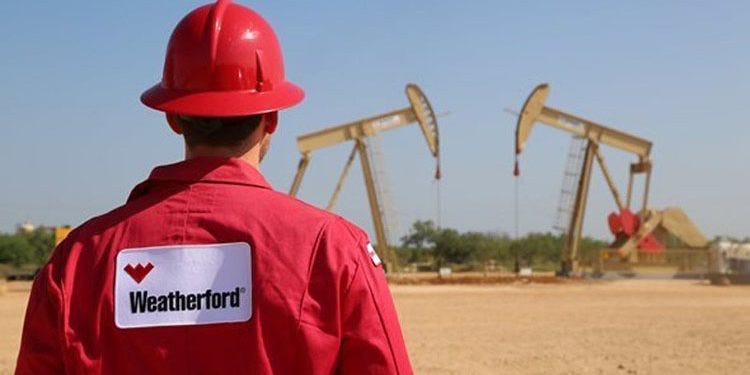
moving its legal home from Ireland to Texas, a transition the company expects to complete in the third quarter of the year pending shareholder approval. Texas is not a new address for this company. It is the original one. Weatherford International traces its roots to 1941, when Jesse E. Hall Senior founded the Weatherford Spring Company in the town of Weatherford, Texas, the actual place the entire company is named after. Between that founding and this year’s announcement, the company spent decades incorporating in Bermuda, then Switzerland, then Ireland, chasing tax efficiency across three different jurisdictions before a bankruptcy, an accounting fraud scandal, and a near total collapse forced a level of self examination that apparently ended with the conclusion that home was the better address after all.
THE EIGHTY FIVE YEAR MACHINE, INTERRUPTED TWICE
Jesse Hall’s spring company had nothing to do with oil at first, but Texas oilfields needed the kind of mechanical parts a spring manufacturer could produce, and the business gradually reoriented itself toward the industry surrounding it. The company that became modern Weatherford traces its more direct corporate lineage to 1972, when Energy Ventures was created as an exploration and production company, trading over the counter with a market capitalization of roughly fifteen million dollars. In 1987, Energy Ventures hired Bernard J. Duroc-Danner to start up an oilfield service and equipment business inside the company, and Duroc-Danner spent the next three decades building it through what would eventually total more than three hundred separate acquisitions. The company renamed itself EVI in 1990, then Weatherford International in 1998, following its own acquisition of the original Weatherford Enterra oilfield services business, and between 1999 and 2008 it grew aggressively by focusing specifically on mature field development, a deliberate departure from the industry’s prevailing focus on new exploration at the time.
Duroc-Danner’s growth strategy eventually collided with the same pressure every fast growing company built through hundreds of bolt on acquisitions eventually faces, the absence of a single unified operating and accounting system underneath all that growth. Between 2007 and 2012, Weatherford issued false financial statements that inflated earnings by more than nine hundred million dollars, achieved by fraudulently lowering the company’s year end income tax provision by roughly a hundred million to a hundred fifty four million dollars annually, adjustments made specifically to align reported results with analyst expectations Weatherford itself had set. Weatherford had spent years touting its favorable effective tax rate to investors as a genuine competitive advantage, and the fraud existed largely to protect that specific narrative once the underlying numbers stopped supporting it on their own. The company was forced to restate its financial statements three separate times across 2011 and 2012. The Securities and Exchange Commission’s Andrew Ceresney summarized the scheme plainly, describing a company that denied investors accurate financial reporting by allowing two executives to manufacture numbers whenever actual results fell short of what had already been promised. Weatherford agreed to pay a hundred forty million dollars to settle the charges in September 2016, with two former tax executives separately charged over their direct role in the scheme. Duroc-Danner, who had run the company for twenty nine years, stepped down as chief executive that same November, replaced on an interim basis by Krishna Shivram before Mark McCollum took over permanently in March 2017.
None of that leadership change repaired the balance sheet fast enough. By 2019, after more than four years without a profitable quarter, Weatherford entered a restructuring support agreement with its creditors and filed a prepackaged Chapter 11 bankruptcy on July 1 2019 in the Southern District of Texas, alongside parallel examinership proceedings in Ireland reflecting the company’s legal domicile at the time. The filing eliminated approximately six point two billion dollars of outstanding debt, and Weatherford emerged from bankruptcy on December 13 2019 with two point six billion dollars in new exit financing facilities and over nine hundred million dollars of liquidity, unsecured noteholders exchanging roughly seven point four billion dollars of senior notes for ninety nine percent of the reorganized company’s equity. The company’s shares had been suspended from New York Stock Exchange trading in May 2019 before the filing, traded briefly on the OTC Pink marketplace afterward, and eventually relisted on the Nasdaq under the ticker WFRD. Girish Saligram was named president and chief executive in September 2020, inheriting a company that had been rebuilt from close to nothing twice in less than a decade, once through fraud that had to be unwound, once through a bankruptcy that reset the capital structure entirely.
THE BUSINESS MODEL, SPREAD ACROSS MORE FLAGS THAN ITS RIVALS
Weatherford organizes its operations into three segments. Drilling and Evaluation covers wireline services, drilling services, and managed pressure drilling, the tools and expertise deployed while a well is actively being drilled. Well Construction and Completions covers cementation products, liner hangers, and completion systems, the work that finishes a well once drilling is done. Production and Intervention covers artificial lift, well intervention, and the equipment that keeps an already producing well flowing efficiently over its lifetime. All three segments share the same short cycle exposure this newsletter has now documented running through every pure services company it has covered, revenue that depends directly on a customer’s decision to spend this quarter rather than next.
What distinguishes Weatherford from Halliburton specifically is geography rather than segment structure. Full year 2025 international revenue came to three point nine three five billion dollars against total revenue of four point nine one eight billion, meaning roughly eighty percent of Weatherford’s business runs outside North America, a materially higher international weighting than Halliburton carries, spread across national oil companies and international majors in the Middle East, Latin America, Europe, Sub-Sahara Africa, Russia, and Asia rather than concentrated in a single dominant basin. The company’s own quarterly contract announcements read almost like a world tour, Kuwait Oil Company, ADNOC, PDO Oman, Eni Oman, Petrobras, YPF, Petronas Indonesia, Pertamina, bp Azerbaijan, all inside a single recent quarter’s operational highlights, a genuinely diversified customer base that gives Weatherford less single country concentration risk than a company leaning more heavily on any one region, even as it means the company has no equivalent to a single dominant home market the way Halliburton has North American shale.
THE NUMBERS, A SMALLER COMPANY RECOVERING IN REAL TIME
Full year 2025 revenue came to four point nine one eight billion dollars, down eleven percent from 2024, with operating income falling nineteen percent to seven hundred fifty six million dollars and net income declining fifteen percent to four hundred thirty one million dollars, an eight point eight percent net margin. The fourth quarter showed real sequential improvement even against a softer year over year comparison, revenue of one point two eight nine billion dollars, down four percent year over year but up five percent sequentially, and net income of a hundred thirty eight million dollars, up a striking seventy percent from the third quarter alone, evidence of a business finding its footing quarter over quarter even as the full year comparison against a stronger 2024 still reads as a decline.
The first quarter of 2026 complicates that recovery narrative directly. Revenue came to one point one five two billion dollars, down three percent year over year and down eleven percent sequentially, operating income fell thirteen percent to a hundred twenty three million dollars, and net income actually rose to a hundred eight million dollars, up forty two percent year over year on a nine point four percent margin, aided by lower tax expense and financing costs even as the underlying operating trend softened. Diluted earnings per share reached one dollar forty nine cents, up forty four percent year over year, a genuinely strong headline number sitting on top of an operating environment management itself described as under real pressure. Weatherford’s own first quarter filing names the cause without euphemism, stating plainly that conflict in Iran and trade and tariff uncertainty disrupted Middle East operations and logistics, producing near term pressure that management expects to potentially recover in the second half of the year. Segment detail confirms the geography of the damage, Drilling and Evaluation revenue fell eight percent year over year specifically on lower activity in Latin America, the Middle East, North Africa, and Asia, partially offset by a seventeen percent year over year increase in Europe, Sub-Sahara Africa, and Russia revenue, the one region where Weatherford’s business actually grew through the same quarter the Middle East was contracting.
THE WAR, NAMED DIRECTLY RATHER THAN IMPLIED
Every services company this newsletter has profiled so far has described the 2026 Iran war’s impact through some version of careful corporate language, disruptions, headwinds, activity softness. Weatherford’s own first quarter 2026 disclosure is the most direct of the three, naming the conflict in Iran specifically as a cause of disrupted Middle East operations and logistics, language that leaves considerably less room for alternative explanation than the general capital discipline framing this newsletter has used to describe North American shale softness elsewhere. Given how heavily Weatherford’s revenue mix leans international relative to Halliburton and Baker Hughes, and given that a meaningful share of that international revenue runs directly through the Middle East, Kuwait, the UAE, Oman, Qatar, Saudi Arabia, all appearing repeatedly in the company’s own recent contract disclosures, the war’s impact on Weatherford is close to a direct read through from regional disruption to reported revenue, without the layer of North American capital discipline complicating the picture the way it does for its larger rivals.
THE INDIA RELATIONSHIP, SMALLER AND DIFFERENTLY SHAPED
Weatherford’s presence in India runs through a different door than the ONGC centered relationships this newsletter has documented for both Baker Hughes and Halliburton. In 2025, Cairn Oil and Gas, the Vedanta owned operator running Rajasthan’s Barmer basin, awarded Weatherford a letter of award covering completions, liner hanger, and whipstock systems alongside managed pressure drilling services for a high temperature, ultra high temperature drilling and rigless project in Barmer specifically, a technically demanding well environment that rewards exactly the kind of completions expertise Weatherford’s Well Construction and Completions segment specializes in. This is a smaller, more specific relationship than the two decade, multi basin ONGC partnership Baker Hughes has built or the broader if more fraught Halliburton ONGC history this newsletter has already covered, evidence that Weatherford’s India strategy runs more through India’s private and semi private operators than through the state owned giant that dominates the country’s upstream sector, a genuinely different entry point into the same country.
WHETHER A SMALLER COMPANY CAN AFFORD TO DIGITIZE ITS WAY FORWARD
Weatherford’s own recent technology investments show a company betting on digital efficiency rather than the kind of structural business model pivot Baker Hughes made through its GE merger and Chart acquisition. The Victus intelligent managed pressure drilling system, deployed for Kuwait Oil Company specifically to improve operational efficiency and accelerate well delivery timelines, and the Real Time Decision Centers Weatherford now operates onshore in Kuwait, both represent a bet that data and automation can extract more value from Weatherford’s existing service lines rather than replace them with an entirely new business line the way Baker Hughes’ turbine business has. The company’s November 2024 acquisition of Datagration, a data and analytics platform for exploration and production operations, points the same direction, adding software capability rather than the kind of long cycle industrial equipment manufacturing Baker Hughes acquired through Chart. Weatherford also signed a strategic training partnership with Maersk Training in February 2026, a smaller but telling signal that even as automation advances, the company still sees enough of a future for human operators in its own service lines to invest in training them better rather than only in replacing them.
The honest read on Weatherford’s replaceability sits closer to Halliburton’s position than to Baker Hughes’. Both remain fundamentally service intensive businesses exposed to short cycle activity decisions, and neither has built anything resembling IET’s long cycle backlog to soften the transition if automation and digitalization eventually do shrink the labor intensity this entire industry has depended on for a century. Weatherford’s smaller size relative to its two larger rivals cuts both ways here, giving the company less capital available to build an equivalent hedge, while its genuinely diversified international customer base gives it less single market concentration risk than Halliburton’s North American weighting carries.
THE POLITICS OF A COMPANY WILLING TO GO WHERE OTHERS WON’T
Weatherford announced its return to operations in Libya in September 2025, reentering a market that has spent more than a decade cycling through civil conflict, competing governments, and periods of near total foreign operator withdrawal. That willingness to reenter genuinely difficult jurisdictions runs through the rest of Weatherford’s current contract book as well, Iraq, Kazakhstan, Turkmenistan, Angola, markets that carry real political risk premiums most of the larger integrated majors this newsletter covers manage more cautiously through joint ventures and phased commitments than a pure services company managing its own direct contract exposure typically can.
The redomestication itself carries its own political logic. Moving from Ireland to Texas simplifies the company’s corporate and tax structure, reduces compliance costs tied to operating a foreign domicile, and, in the company’s own stated reasoning, provides access to a larger pool of American shareholders and lenders while enabling more agile management of global tax considerations, language that reads as a polite way of saying the offshore domicile strategy Duroc-Danner era leadership once pursued for tax efficiency no longer clears the cost benefit bar it once did, now that the company is smaller, more scrutinized, and less able to absorb the administrative overhead multiple international jurisdictions require.
WHAT THE TAPE IS SAYING NOW
China exports deflation into whatever industry it decides to scale, and Weatherford’s own contract book, spread thin across dozens of national oil companies and international operators rather than concentrated in a single scarce resource the way Baker Hughes’ turbine business currently is, sits fully exposed to that mechanism. Every contract this newsletter has cited from Weatherford’s own recent disclosures, three year extensions, five year frame agreements, one year renewals, describes a company competing quarter after quarter, region after region, against Halliburton, SLB, and a long tail of smaller regional players for the same finite pool of global drilling and completion spending. There is no scarcity premium anywhere in this business model. There is only competitive execution, contract by contract, in exactly the kind of oversupplied services market this newsletter has now documented squeezing every pure services company it has examined.
STRESS TEST
The Middle East war’s direct, company acknowledged impact on operations and logistics remains unresolved, and management’s own stated expectation of a second half 2026 recovery is a forecast, not a certainty, in a conflict this newsletter has already documented running longer and less predictably than most participants initially expected.
The redomestication carries real execution risk of its own, still subject to shareholder approval and other customary conditions as of this writing, a corporate transition layered on top of an already volatile operating environment.
Weatherford’s smaller scale relative to Halliburton and Baker Hughes leaves less room for absorbing a second shock, whether from the war, from a renewed North American slowdown, or from losing any single one of the many national oil company relationships the company’s diversified but individually smaller contract book depends on.
The company’s history of fraud and near collapse is not ancient, well within the working memory of investors and customers who lived through both the restatement scandal and the bankruptcy, a reputational overhang that likely still costs Weatherford some pricing power and contract trust relative to rivals who never had to rebuild from zero the way this company has, twice, in less than fifteen years.
THE INSTITUTIONAL LABEL
Weatherford recovers. Named after a Texas town it spent decades legally fleeing for tax reasons, run through a fraud scheme that inflated earnings by nine hundred million dollars, forced through a bankruptcy that wiped out ninety nine percent of the equity value the fraud years had built, and now, finally, coming home, both literally, with the Texas redomestication, and figuratively, with a business that has spent the years since 2019 rebuilding one three year contract at a time rather than one accounting adjustment at a time. Halliburton grinds against a concentrated North American shale cycle. Baker Hughes reinvents itself into an entirely new industrial identity. Weatherford simply recovers, slower, smaller, and more cautiously than either of its larger rivals, from a fall that was almost entirely self inflicted.
SOURCES
Weatherford International fourth quarter and full year 2025 results, Form 8-K, February 3 2026. Weatherford International first quarter 2026 results, Form 8-K and Form 10-Q, April 21 2026. Wikipedia, Weatherford International corporate history. SEC press release and Whistleblower News, Weatherford accounting fraud settlement, September 27 2016. Financier Worldwide, JPT SPE, and Rigzone, Weatherford Chapter 11 bankruptcy filing and emergence, July through December 2019. Empor.top, Weatherford International complete company history and accounting scandal analysis. GlobeNewswire, The Globe and Mail, Nasdaq, and Energy Digital, Weatherford first quarter 2026 results and redomestication announcement, April 21 2026. TradingView, Weatherford first quarter 2026 10-Q analysis including Iran conflict and tariff impact commentary. StockTitan, Weatherford and Noble Corporation managed pressure drilling and aftermarket agreement, May 5 2026. Weatherford International Form 8-K operational and commercial highlights, first through third quarter 2025, including the Cairn Oil and Gas Barmer, India contract award and the Libya return to operations announcement. KeyFactsEnergy, Weatherford press release index, 2024 through 2026.