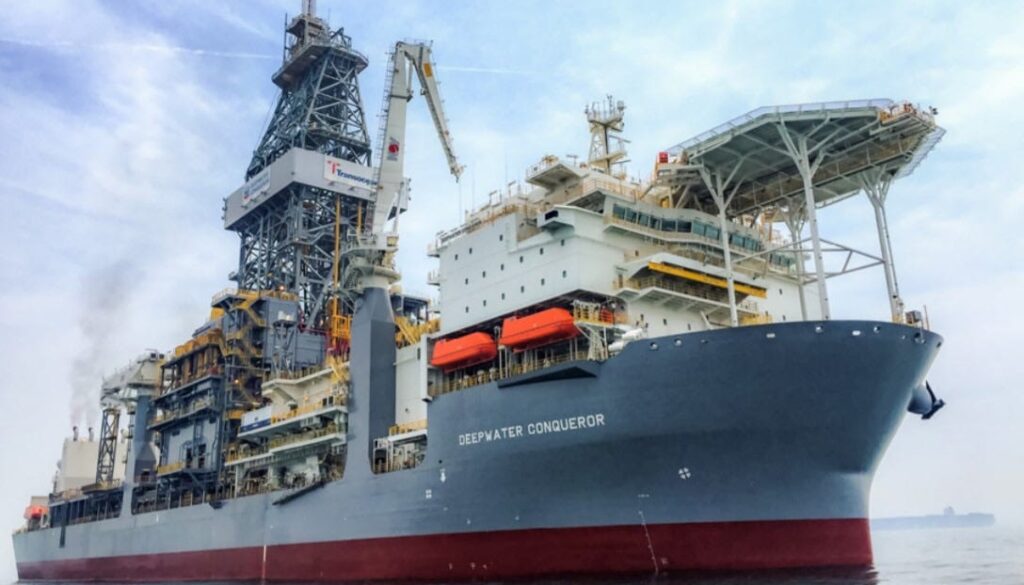
Transocean: The Deepwater Kraken
February 9 2026. Transocean and Valaris announce a definitive agreement to combine, an all stock transaction valuing Valaris at
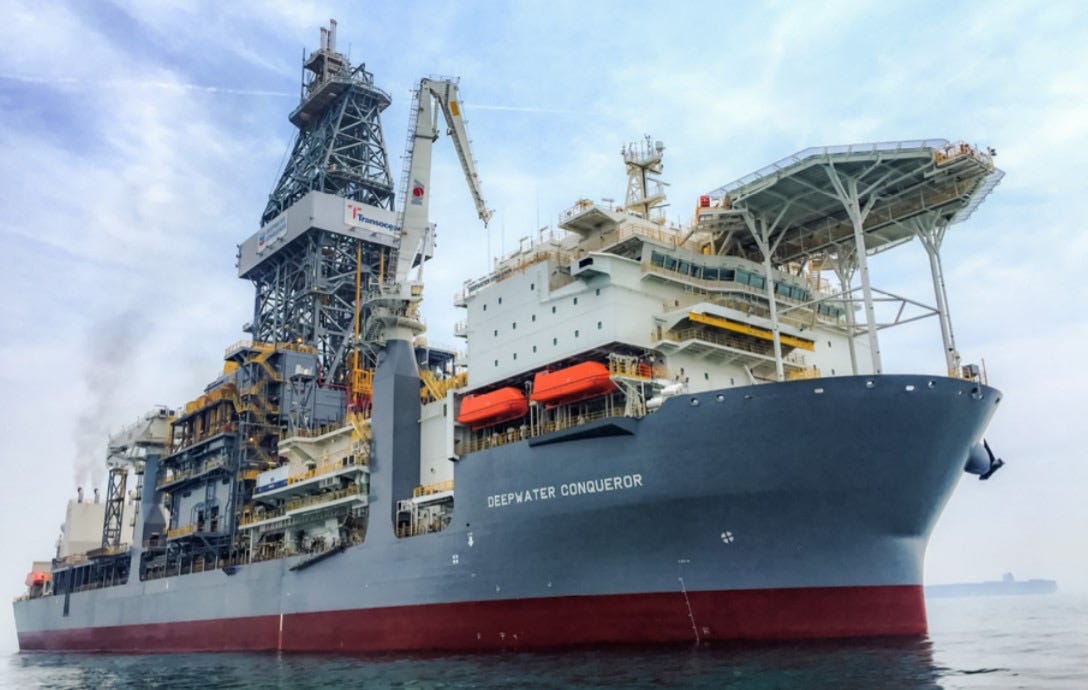
roughly five point eight billion dollars, creating a combined company with a pro forma enterprise value near seventeen billion dollars and, once regulators sign off, control over the largest concentration of ultra deepwater and harsh environment drilling capacity on earth. Transocean shareholders will own fifty three percent of the combined entity, Valaris shareholders forty seven, and the new board will seat nine Transocean directors against two from Valaris, a structure that leaves little ambiguity about which company absorbed which. This is the same Transocean that owned and operated the Deepwater Horizon, the rig at the center of the worst offshore oil spill in American history, a company found thirty percent liable for a disaster it has spent the years since paying to move past, now consolidating its way toward something close to market dominance over the exact business line that disaster was supposed to have permanently scarred.
THE HUNDRED YEAR MACHINE, BUILT ALMOST ENTIRELY THROUGH MERGERS
Transocean’s roots run back to 1926, when a draftsman and landman named T.S. Stoneman bought his first drilling rig with a personal check while working for the Danciger Oil and Refining Company in Fort Worth, Texas, a detail the company itself treats seriously enough to mark 2026 as its centennial year despite the modern corporate entity bearing little resemblance to anything Stoneman would have recognized. The more direct lineage starts in 1953, when Southern Natural Gas Company created The Offshore Company specifically to solve a gap in mobile offshore drilling capacity for the Gulf of Mexico, launching Rig 51 the following year as the world’s first mobile jackup drilling rig, a genuine industry first that established the company’s identity as a technology pioneer rather than a mere operator from its earliest days.
What followed for the next seven decades is less a single company’s growth story than a running tally of consolidation. Sonat Offshore Drilling merged with the Norwegian firm Transocean ASA in 1996 for one point five billion dollars, adopting the Transocean name. A three point two billion dollar merger with Sedco Forex followed in 1999, itself the product of an earlier merger between the Southeastern Drilling Company and the French firm Forages et Exploitations Petrolieres. In 2000 came the acquisition that would define the company’s future liability as much as its future fleet, seventeen point seven billion dollars for R&B Falcon Corporation and its hundred fifteen drilling rigs, a deal that made Transocean the world’s largest offshore drilling operation overnight and brought with it, almost as an afterthought inside such a large transaction, a single semisubmersible rig named Deepwater Horizon. The 2007 merger with GlobalSantaFe Corporation, valued at fifty three billion dollars, cemented Transocean’s position as the industry’s dominant player, and the following year the company moved its place of incorporation from the Cayman Islands to Switzerland, a decision significant enough to trigger removal from the S&P 500 index, since the index’s rules did not accommodate the new domicile.
Two years after that move, on April 20 2010, a blowout at BP’s Macondo well triggered an explosion aboard the Deepwater Horizon that killed eleven crew members and led, two days later, to the rig’s collapse and the start of an oil spill that would run for eighty seven days before the well was finally capped, the largest marine oil spill in history. Transocean was found responsible for thirty percent of the total liability, and a Transocean subsidiary agreed in January 2013 to plead guilty to a single misdemeanor violation of the Clean Water Act, paying four hundred million dollars in criminal fines and penalties alongside a separate one billion dollar civil settlement, one point four billion dollars total, the second largest environmental crime recovery in American history behind only BP’s own four billion dollar criminal settlement for the same disaster. Transocean was sentenced to five years of federal probation, the maximum term the law allowed, and agreed to a consent decree requiring measurable improvements to its drilling safety and emergency response practices.
The company kept consolidating regardless. Aker Drilling’s harsh environment Norwegian fleet came aboard for two point two billion dollars in 2011. Songa Offshore’s completion closed in January 2018, and Ocean Rig followed the same year for two point seven billion dollars. The Valaris combination, announced this February, is simply the latest and largest chapter in a strategy Transocean has run continuously since the 1990s, buying scale and capability rather than building it, a pattern the company’s own centennial framing quietly acknowledges by celebrating a hundred years of a business that has spent most of those years being assembled out of other companies’ fleets rather than growing organically from within a single one.
THE BUSINESS MODEL, A DAY RATE BET ON A RIG THAT ALREADY EXISTS
Transocean’s business runs on a fundamentally different mechanism than any of the three oilfield services companies this newsletter has already profiled. Halliburton, Baker Hughes, and Weatherford sell expertise, equipment, and labor against a customer’s decision to spend this specific quarter. Transocean sells the rig itself, a mobile offshore drilling unit already built, staffed, and maintained, leased to an oil company at a negotiated day rate for a contract that can run months or years, with premium ultra deepwater rigs currently commanding day rates above six hundred thousand dollars. This structure gives Transocean something none of the pure services companies carry, a backlog, the total value of contracted future work already signed and locked in, which stood at roughly six point one billion dollars as of February 2026, providing multi year revenue visibility no quarter to quarter services business can match. The tradeoff is capital intensity on a scale services companies never face. A single ultra deepwater drillship can cost hundreds of millions of dollars to build and tens of millions annually to maintain, whether or not a customer is currently paying to use it, meaning Transocean’s entire economic model depends on keeping an enormously expensive fleet as close to fully utilized as physically possible.
The fleet itself splits into two broad categories, floaters, semisubmersibles and drillships capable of operating in deep and ultra deep water without a fixed connection to the seabed, and jackups, rigs that extend legs down to the seafloor for shallower water work. Transocean has spent the past decade deliberately narrowing its focus toward the highest specification end of the floater market, ultra deepwater and harsh environment rigs capable of commanding premium day rates precisely because so few competitors can build or operate equipment to the same standard, a scarcity based strategy distinct from the volume based competition defining the pure services segment this newsletter has already documented running thin margins for Halliburton and Weatherford alike.
THE NUMBERS, WHERE OPERATIONAL STRENGTH AND A HEADLINE LOSS COEXIST
Full year 2025 contract drilling revenue reached three point nine six five billion dollars, up thirteen percent from 2024, with adjusted EBITDA climbing nineteen percent to one point three seven billion dollars and revenue efficiency, the percentage of available rig time actually billed, reaching ninety six point five percent, a genuinely strong operational year by every metric management directly controls. Cash flow from operations jumped sixty eight percent to seven hundred forty nine million dollars, free cash flow reached six hundred twenty six million dollars, and the company cut total debt by one point two five eight billion dollars to five point six eight six billion, while adding eight hundred thirty nine million dollars of new contract backlog at a weighted average day rate of four hundred fifty three thousand dollars.
Against all of that operational strength, Transocean reported a full year net loss attributable to controlling interest of two point nine one five billion dollars, three dollars and four cents per diluted share, a number that reads as a genuine crisis until its actual source becomes clear. Three billion thirty six million dollars of asset impairment charges, recognized as the company wrote down the value of aging rigs it determined were worth less than their carrying value, including the ultra deepwater floaters Deepwater Nautilus, Development Driller III, and Discoverer Inspiration once those units were classified as held for sale, drove essentially the entire loss. Strip out the impairments and a ninety nine million dollar loss on a debt conversion, and Transocean actually generated thirty seven million dollars of adjusted net income for the year. This is the recurring pattern investors following this stock have learned to read past, strong and improving operational metrics sitting underneath large, non cash impairment charges as the company continuously prunes its oldest, least competitive rigs from an otherwise increasingly premium fleet, a bookkeeping reality that punishes the headline number specifically because Transocean is doing the fleet discipline work a capital intensive business is supposed to do.
THE VALARIS MERGER, CONSOLIDATION AT A SCALE THE INDUSTRY HAS NOT SEEN
The Business Combination Agreement signed February 9 2026 structures the deal as a court sanctioned scheme of arrangement under Bermuda law, Valaris being a Bermuda incorporated company, with each Valaris share converting into fifteen point two three five Transocean shares, implying a value of roughly eighty two dollars twelve cents per Valaris share at signing, a thirty one point six percent premium to Valaris’ prior closing price. The deal followed a competitive process, Transocean having pursued and then walked away from a different unnamed target, referred to in filings only as Transocean Party A, before returning with what regulatory filings describe as its best and final offer for Valaris on February 6. Both boards approved the agreement unanimously, and major shareholders on both sides, including Perestroika AS, a Cyprus based entity affiliated with a Transocean director that holds roughly nine percent of Transocean’s own shares, along with Famatown Finance and Oak Hill Advisors holding a combined eighteen percent of Valaris, signed support agreements backing the transaction. The combination is expected to close in the second half of 2026, subject to shareholder votes on both sides, court sanction in Bermuda, and regulatory approval.
The competitive implications are the part worth sitting with longest. Transocean and Valaris are, between them, two of the three or four companies capable of building and operating the highest specification ultra deepwater rigs on earth. Combining them does not just create scale, it materially reduces the number of independent bidders an oil major or national oil company can play against each other when negotiating a day rate for the kind of rig only a handful of companies in the world can actually supply. Every prior Transocean merger this issue has documented followed the same logic, more scale, fewer genuine competitors at the premium end of the fleet, and the Valaris combination simply completes that decades long pattern at a scale the offshore drilling industry has not previously seen concentrated inside a single company.
THE DISASTER THAT NEVER FULLY LEAVES THE STORY
This newsletter’s Halliburton issue already documented that company’s one point one billion dollar Deepwater Horizon settlement, its role limited to the cementing work performed on the Macondo well. Transocean’s exposure ran deeper, since Transocean owned and operated the rig itself, including the blowout preventer and riser that failed to stop the disaster once it began. Assistant Attorney General Lanny Breuer’s own language framing the 2013 settlement placed direct blame on Transocean’s rig crew for accepting BP’s direction to proceed in the face of clear danger signs, a characterization a Transocean subsidiary accepted when it pleaded guilty on behalf of the broader Transocean group. Three different companies, BP, Transocean, and Halliburton, ultimately paid out a combined total exceeding six billion dollars in criminal and civil penalties tied to a single well, a reminder that a catastrophic failure in this industry rarely traces to one company’s negligence alone, and that the companies this newsletter covers individually are, more often than readers might assume, entangled in the same disasters from different angles of the same well.
INDIA, A RECORD SET RATHER THAN A RELATIONSHIP BUILT
Transocean’s most notable India connection is a technical record rather than an ongoing commercial partnership on the scale this newsletter has documented for Baker Hughes or even Halliburton. The Dhirubhai Deepwater KG2, a Transocean rig, set a world water depth drilling record of ten thousand one hundred ninety four feet while working for Reliance Industries off India’s coast, a genuine engineering milestone that put Indian deepwater exploration on the map for the global offshore industry at the time. Beyond that specific achievement, Transocean’s current India footprint appears considerably thinner than its Middle East, North Sea, and Latin American presence, worth noting honestly rather than stretched into a relationship the available evidence does not support at the depth this newsletter found for other companies in this sector.
WHETHER THE WAR ACTUALLY REACHES THIS BUSINESS MODEL
Transocean’s exposure to the 2026 Iran war looks structurally different from every services company this newsletter has covered, precisely because of the backlog mechanism underlying its business model. A war disrupting this quarter’s activity barely touches revenue already locked into a multi year day rate contract signed before the conflict began, the same insulation this newsletter documented running through Baker Hughes’ Industrial and Energy Technology backlog. Where the war actually matters for Transocean is at the point of new contracting, whether oil majors and national oil companies currently negotiating day rates for 2027 and beyond adjust their offshore capital spending plans in response to sustained regional instability, a slower moving and less immediately visible risk than the direct quarterly revenue hits this newsletter documented at Halliburton and Weatherford.
WHAT THE TAPE IS SAYING NOW
China has repeatedly exported cost deflation into industries where it has built overwhelming manufacturing scale, and premium offshore drilling capacity is currently running in the opposite direction entirely, the same scarcity dynamic this newsletter documented driving Baker Hughes’ turbine pricing power. Years of depressed day rates following the 2014 and 2020 downturns pushed the entire industry to scrap older rigs and build almost nothing new, leaving a genuinely constrained supply of high specification floaters just as offshore project economics have improved enough to justify new deepwater final investment decisions. Rystad Energy’s own research shows annual greenfield offshore capital expenditure broke the hundred billion dollar threshold in both 2022 and 2023 for the first time in a decade, with more than two hundred billion dollars of new offshore project investment lined up across those two years alone, and Rystad’s most recent industry outlook projects capacity constraints across subsea vessels, deepwater rigs, and floating production equipment building through 2026 and intensifying further in 2027 as a new wave of deepwater and LNG linked final investment decisions reaches completion. Transocean’s own newbuild program, anchored by the Deepwater Titan, the first drillship rated for twenty thousand psi operations and capable of unlocking Paleogene reservoirs in the Gulf of Mexico previously out of reach for lower rated equipment, positions the company at the exact scarce, high specification end of a market where the Valaris combination will only concentrate pricing power further.
STRESS TEST
Continued impairment charges are close to a structural certainty rather than a one time event, since Transocean’s strategy explicitly involves scrapping its oldest rigs as they age out of competitiveness, meaning future headline net losses driven by non cash writedowns should be read in the same context as 2025’s rather than treated as a fresh crisis each time they recur.
The Valaris merger carries real integration and regulatory risk, still subject to shareholder votes on both sides, Bermuda court sanction, and antitrust review in a combination material enough to meaningfully concentrate the ultra deepwater rig market, any of which could delay or complicate the transaction before its targeted second half 2026 close.
Day rate cyclicality has not disappeared simply because the current environment favors premium rig owners. A sustained oil price decline serious enough to push oil majors toward deferring offshore final investment decisions would hit Transocean’s backlog renewal rate directly, the same vulnerability that produced the depressed day rate years the company’s current scarcity advantage is a direct reaction against.
THE INSTITUTIONAL LABEL
Transocean consolidates. A hundred years removed from a landman’s personal check for a single drilling rig, the company has built its entire modern identity through acquisition after acquisition, Sonat, Sedco Forex, R&B Falcon, GlobalSantaFe, Aker, Songa, Ocean Rig, and now Valaris, each deal adding scale and, more quietly, reducing the number of genuine competitors capable of matching Transocean’s premium fleet. The Deepwater Horizon disaster interrupted that pattern for exactly as long as the legal and financial consequences took to resolve, and not one day longer. Sixteen years after a rig this company owned killed eleven people and triggered the worst oil spill in American history, that same company is finishing the largest consolidation of offshore drilling capacity the industry has ever seen, and the market has, by and large, decided the disaster is a settled cost rather than a permanent ceiling.
SOURCES
Transocean Ltd. fourth quarter and full year 2025 results, Form 8-K, February 19 2026. Transocean Ltd. and Valaris Limited joint Business Combination Agreement and press release, Form 8-K and DEFA14A, February 9 2026. Transocean and Valaris preliminary merger proxy statement, Form PREM14A, May 19 2026. Wikipedia, Transocean corporate history and Deepwater Horizon incident. Deepwater.com, Transocean official company history and centennial timeline. StockTitan and TipRanks, Transocean fourth quarter and full year 2025 results analysis, February 20 2026. US Department of Justice, Environmental Protection Agency, and NOLA.com, Transocean Deepwater Horizon Clean Water Act guilty plea and one point four billion dollar settlement, January 2013. Transocean Ltd. Form 10-Q, third quarter 2025, rig impairment disclosures. PortersFiveForce.com and MatrixBCG.com, Transocean fleet composition and newbuild program, including the Deepwater Titan twenty thousand psi drillship.