HPCL: An ONGC Subsidiary
HPCL’s Q1 FY27 results, released in the same window as ONGC’s, tell the same structural
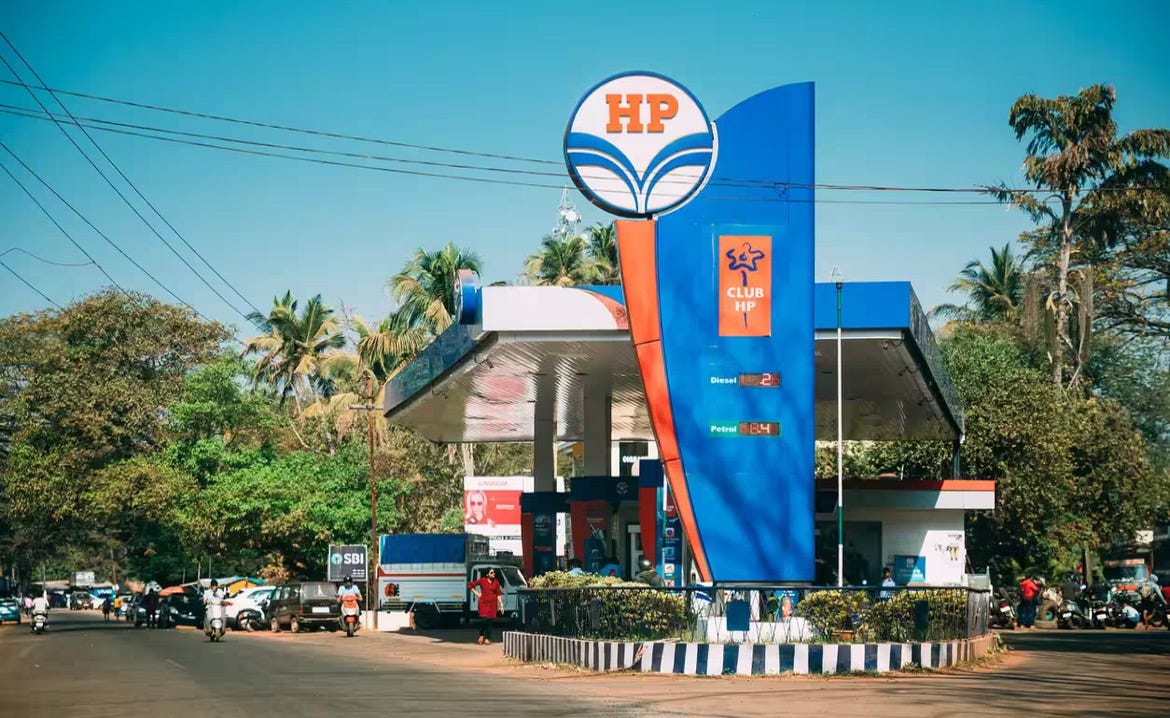
story this project has now documented across two consecutive quarters and two companies. Gross Refining Margin surged to $23.80 a barrel from $3.08 a year earlier, a genuinely extraordinary improvement by any historical standard. Consolidated net loss for the quarter still came in at ₹12,265 crore, reversing a ₹4,111 crore profit a year earlier. Standalone, the loss ran to ₹11,526 crore against a ₹4,371 crore profit. Revenue grew 20.9% to ₹1,45,126 crore. Pre-tax loss stood at ₹17,446 crore against a ₹5,826 crore profit before tax a year earlier. Consolidated downstream petroleum segment losses alone reached ₹17,713 crore, against a ₹6,144 crore profit in the same quarter last year. Read GRM in isolation and this looks like HPCL’s best quarter in years. Read the bottom line and it looks like HPCL’s worst. Both readings are correct, and the gap between them is the entire subject of this piece.
What HPCL Actually Runs
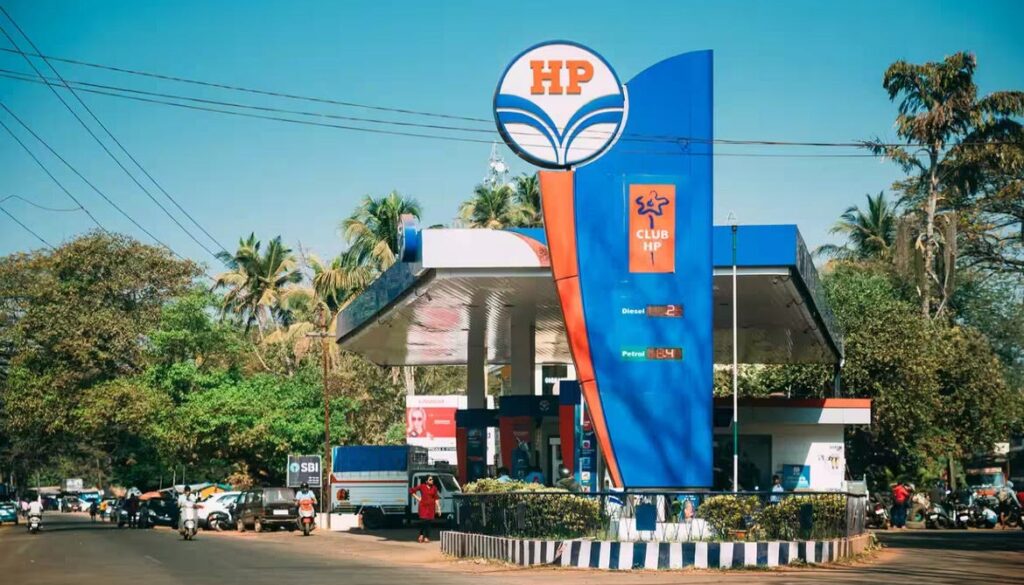
HPCL’s refining capacity share of India’s total stood at 13.44% as recently as March 2025, and jumped to 16.77% as of July 1, 2026, following the commissioning of the HPCL Rajasthan Refinery, the Barmer, Pachpadra complex, commercial operations declared June 22, 2026 and dedicated to the nation by the Prime Minister on July 4, 2026. Built through the HPCL Rajasthan Refinery Limited joint venture at an investment of roughly ₹79,459 crore, the plant adds 9 MMTPA of refining capacity and 2.4 MMTPA of petrochemical capacity, and pushes HPCL past BPCL to become India’s second largest state owned refiner by capacity, behind only IOCL. Domestic petroleum products market share stands at 20.73% as of the same date, built through 25,160 retail outlets, 6,391 LPG distributorships, 1,638 kerosene and light diesel oil dealerships, and 543 lube distributors, making HPCL the country’s second largest retail network holder and second largest LPG marketer. Beyond Mumbai and Visakhapatnam, its two wholly owned refineries, HPCL holds 48.99% of HMEL, the Bathinda refinery joint venture in Punjab, giving the company a genuinely national refining footprint across west, east and north India even before Barmer’s capacity is fully ramped.
Full year FY26 results, the baseline against which this quarter’s reversal has to be read, showed revenue of ₹4,78,543 crore and profit after tax of ₹17,175 crore, up 133% year on year, on crude throughput of 26.0 MMT and market sales of 51.4 MMT including exports, at a GRM of $8.79 a barrel gross of export cess. Refinery utilisation ran hot across the network, Mumbai at 105% to 107%, Vizag at 106% to 112%, HMEL at 103% to 116%, the same pattern of assets running above nameplate capacity this project has already flagged in the IOCL piece as a system wide signal that India’s refining base is being pushed harder than its design margins were built for.
GRM Versus Under-Recovery, The Mechanism Behind This Quarter’s Contradiction
Gross Refining Margin measures only one stage of HPCL’s business, the difference between the value of the refined products a barrel of crude yields and the cost of that crude, captured at the refinery gate. It says nothing about what happens between the refinery gate and the retail pump. When crude prices spike sharply, as they did through Q1 FY27 amid the same West Asia crisis this project has tracked across ONGC’s results and Issue 66’s political timeline, GRM often widens because product prices, set with reference to international benchmarks, adjust faster than crude costs work through a refiner’s existing inventory, a timing effect that flattered this quarter’s $23.80 a barrel figure. But HPCL, like IOCL and BPCL, sells the bulk of its petrol and diesel into a domestic retail market where prices are adjusted with real, if inconsistent, political sensitivity to the pace and size of increases, detailed further below. When the retail price a marketing company can charge does not rise as fast as the cost of the product it is buying, refined or imported, the marketing segment absorbs the gap as an under-recovery, and that under-recovery this quarter, ₹17,713 crore at the downstream petroleum segment level, was large enough to erase not just the refining segment’s genuinely strong quarter but push the whole consolidated result deep into loss. This is the precise mechanical reason a company can report its best GRM in years and its worst quarterly loss in years inside the same set of financial statements.
Deregulated On Paper
India formally deregulated petrol pricing effective June 26, 2010, and diesel pricing effective October 19, 2014, moving from the earlier Administered Pricing Mechanism, dismantled in 2002, through Trade Parity Pricing from 2006, to a system of daily price revisions beginning June 2017, in principle a fully market linked mechanism no different from how a private refiner would price fuel. In practice, and this project detailed the clearest recent example in the IOCL piece, retail prices are still frozen during periods of high volatility or around elections with enough regularity that the pattern is now a recognised feature of how Indian OMCs operate, not an exception to deregulation. The roughly 137 day freeze that ran from November 2021 through March 2022, spanning assembly elections in five states, is the most documented case, but the mechanism itself, price stability prioritised over strict cost pass through whenever the political calendar or public sentiment makes a large increase inconvenient, did not end with that episode. HPCL’s Q1 FY27 loss is this same mechanism operating in reverse, a crude spike large enough that even a government inclined to allow gradual pass through could not close the gap fast enough to prevent a genuinely severe quarterly loss at the marketing segment.
Why The Market Prices HPCL The Way It Does
HPCL’s market capitalisation stood at roughly ₹84,613 crore in the most recent disclosed figure this project could verify, against net debt of ₹57,913 crore as of September 2025, down from ₹65,930 crore in March 2025, implying an enterprise value in the range of ₹1.4 lakh crore to ₹1.5 lakh crore depending on the exact date of comparison. Trading multiples sit at a P/E of roughly 7.1 and an EV/EBITDA of roughly 6.0, both low by the standards of a company that just delivered a 133% profit jump in the fiscal year immediately preceding this quarter’s loss. This gap between operational performance and valuation multiple is not unique to HPCL. It is the standard market treatment applied to all three Indian public sector oil marketing companies, and it reflects a structural discount rather than a company specific judgment, the market pricing in the recurring risk that the same government intervention detailed above will, in any given quarter, override whatever the underlying refining and marketing economics actually produced. A private, fully deregulated refiner’s earnings are volatile because commodity markets are volatile. An Indian OMC’s earnings are volatile for that reason and for a second, entirely separate reason, the timing of when the government allows a price increase to actually reach the pump, and a market pricing in two sources of volatility rather than one will structurally assign a lower multiple to the same rupee of trailing earnings.
The ONGC Ownership Structure
ONGC acquired the Government of India’s entire 51.11% equity stake in HPCL in January 2018, paying ₹36,915 crore, ₹473.97 a share, a 14% premium to HPCL’s ₹417 close on the preceding trading day. At that share price, HPCL’s implied full market capitalisation stood in the region of ₹63,000 crore to ₹64,000 crore, meaning ONGC’s ₹36,915 crore outlay bought slightly over half the company at a genuine premium, not a distressed or discounted price. ONGC financed the purchase through a combination of cash on hand and its first ever corporate debt, tying up more than ₹18,000 crore in loans from Punjab National Bank, Bank of India and Axis Bank within days of the deal closing, alongside board approval to raise its own borrowing limit from ₹25,000 crore to ₹35,000 crore. HPCL’s own debt at the time sat in the ₹12,200 crore to ₹21,250 crore range across the two quarter ends nearest the transaction, a figure that has since grown to the ₹57,913 crore to ₹65,930 crore range disclosed for 2025, consistent with the broader capital intensity of the Barmer refinery build and the company’s ongoing expansion programme rather than any single event.
The Cabinet’s own structuring of the deal specified from the outset that HPCL would not be merged into ONGC but would continue operating as a separate, independently listed entity, becoming an ONGC subsidiary in ownership terms while retaining its own board and management. That structure has proven genuinely unusual by the standards of ONGC’s other subsidiaries. MRPL, OVL and OPaL are each headed by a chief executive who reports into a board chaired by the ONGC chairman and managing director. HPCL has continued to operate with its own chairman and managing director, a role that has not reported to the ONGC board, and ONGC has held only a single board seat at HPCL in the years since the acquisition closed, a configuration a joint synergy panel, comprising a former oil secretary and former heads of both ONGC and HPCL, was specifically convened to examine. That panel’s report, submitted in 2024, recommended aligning HPCL’s governance with the rest of the ONGC group by having the ONGC chairman also chair HPCL’s board, consistent with what the panel described as the standard practice for a company with subsidiaries under a single corporate umbrella. Whether and when that recommendation is implemented remains a matter for the two companies and the Ministry of Petroleum and Natural Gas to work through, and this project will report on it as a structural governance question rather than take a position on what the right outcome should be. What can be stated plainly is that seven years after the ownership transaction closed, HPCL’s day to day management structure looks less integrated into ONGC than any of the group’s other subsidiaries, a genuinely distinctive feature of how this particular deal was designed and has evolved, worth understanding on its own terms rather than assuming it mirrors a conventional parent subsidiary relationship.
The Stress Test
HPCL’s ROCE for Q1 FY27 came in at negative 14.0%, and EPS at negative ₹57.64 for the quarter, figures that describe genuine financial stress rather than a rounding effect. Set against that, the company’s operational fundamentals, refinery utilisation running consistently above 100% across every major asset, a newly commissioned Barmer complex adding meaningful scale, and a Samriddhi 2.0 efficiency programme targeting ₹1,500 crore in EBITDA gains, of which ₹1,000 crore is targeted for FY27 accrual alone, following Samriddhi 1.0’s delivery of ₹1,691 crore in FY26, point toward a company whose underlying execution remains sound even as a single quarter’s crude spike overwhelmed the marketing segment’s ability to keep pace. The real question for the next several quarters is the same one this project raised in the IOCL piece, whether pending price adjustments allow the marketing segment to recover the gap opened this quarter, and how much of that recovery lands before the next volatility event, whatever its source, opens a new one.
Sources: HPCL Q1 FY27 results as reported by Tradebrains, EquityBulls, Indian Masterminds, MarketsMojo and Business Standard, July and August 2026. HPCL Q2 FY26 and FY26 investor presentations, hindustanpetroleum.com. Investing.com summary of HPCL’s July 2026 investor update slides. Screener.in and Tijori Finance company disclosure summaries on HPCL shareholding, debt, and valuation multiples. Business Standard reporting on the January 2018 ONGC-HPCL transaction, ONGC’s acquisition financing, and HPCL’s FY2017-18 debt levels. Business Standard reporting on the ONGC-HPCL synergy panel report, October 2024. Bajaj Finserv comparative summary of IOCL, BPCL and HPCL, July 2026.