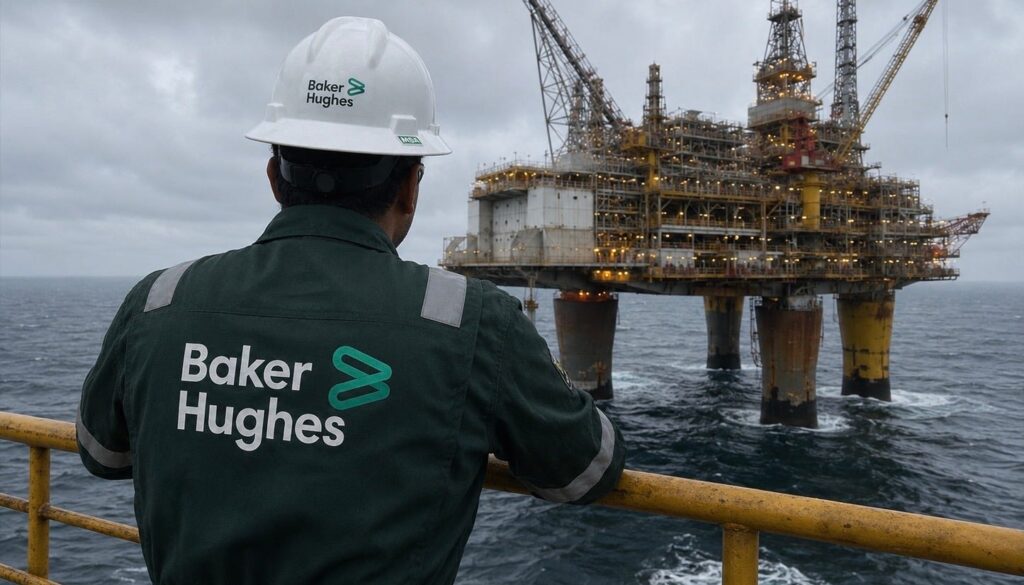
BAKER HUGHES: From Modern Oil Wells to Powering AI Boom
July 8 2026, The Woodlands, Texas. Kodiak Gas Services and Baker Hughes
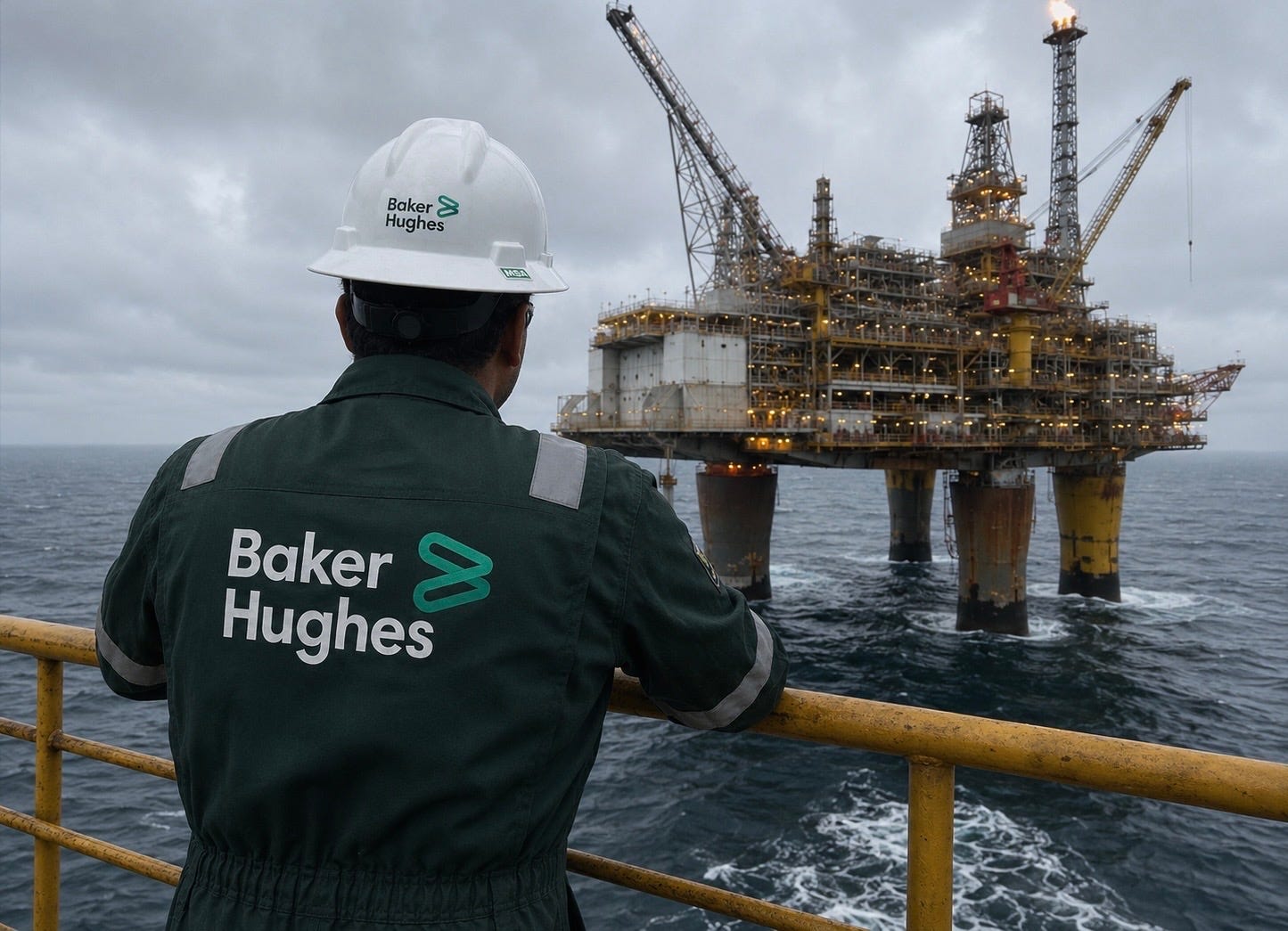
announce a multi year agreement anchored by an initial order for roughly a gigawatt of gas turbines and generators, deliverable by 2030, with a stated pathway toward one point eight gigawatts if the relationship keeps expanding. The turbines are destined for behind the meter power plants feeding data centers, the physical infrastructure underneath the artificial intelligence buildout every technology company on earth is racing to fund. A gigawatt is enough electricity for roughly seven hundred thousand American homes. Baker Hughes is now in the business of building that much generating capacity for a single customer’s server farms.
One hundred seventeen years earlier, in 1909, a Texas oilman named Howard R. Hughes Senior and his partner Walter Sharp patented a two cone rotary drill bit that let wells punch through hard rock formations no fishtail bit could penetrate. That patent is the actual origin point of the modern oil industry’s ability to drill deep, and it is also, through an unbroken corporate lineage running merger through merger for more than a century, the same company now selling gigawatts of turbine capacity to power artificial intelligence. Understanding how a rock bit patent from the Taft administration turned into a data center power supplier is the entire subject of this issue, because the mechanism connecting those two facts is not incidental. It is the whole business model.
THE HUNDRED SEVENTEEN YEAR MACHINE
Two separate men built the companies that eventually became Baker Hughes, and neither one set out to build an oilfield services conglomerate. Reuben C. Baker, an inventor working the Coalinga oil fields of California, patented a casing shoe in 1907 that solved a specific mechanical problem, keeping a well’s steel casing properly seated against hard rock formations during cementing. He incorporated the Baker Casing Shoe Company the same year, which grew through the following decades into Baker Oil Tools, then Baker International by 1976. Howard Hughes Senior, working alongside Walter Sharp in Houston, solved a different problem entirely, how to drill through rock formations too hard for the fishtail bits then in common use. Their two cone roller bit, patented in 1909, worked so well that Hughes maintained a near total monopoly on hard rock drilling technology for decades simply by patenting every conceivable variation of his own design and buying up any competing patents that emerged. When Sharp died in 1912, Hughes bought out his widow’s stake and renamed the company Hughes Tool in 1915. When Hughes himself died in 1924, his son, the aviator and film producer Howard Hughes Junior, inherited the company and used its steady drill bit profits to fund an entirely unrelated empire in aviation, motion pictures, and Las Vegas real estate for the next four decades, eventually selling Hughes Tool’s actual tool division to the public in 1972.
Baker and Hughes operated as separate companies, competitors even, for most of the twentieth century, until the mid 1980s oil price collapse forced a reckoning across the entire oilfield services industry. In 1987, Baker International and Hughes Tool merged to form Baker Hughes Incorporated, a deal complicated enough that it nearly fell apart entirely. The Justice Department moved to block the merger on antitrust grounds, forcing a consent decree that required divesting Hughes’ Reed Tool subsidiary. Hughes then attempted to walk away from the agreement after accepting those terms, and Baker responded by threatening to sue for a billion dollars if the deal collapsed, a threat serious enough that Hughes shareholders overruled their own management and voted to complete the merger anyway. The combined company emerged as the second largest oilfield services provider on earth, trailing only Schlumberger, and immediately began the acquisition pattern that would define the next four decades, Eastman Christensen’s directional drilling technology in 1990, Teleco’s measurement while drilling capability in 1992, Western Atlas’ seismic and wireline business for roughly three point three billion dollars in 1998, and BJ Services’ pressure pumping and hydraulic fracturing capacity for five point five billion dollars in 2010.
The single most consequential deal in the company’s modern history arrived in 2017, when Baker Hughes merged with General Electric’s oil and gas division to form Baker Hughes, a GE Company, with GE holding sixty two point five percent of the combined entity. That merger did more than add GE’s turbine and compression manufacturing capability to Baker Hughes’ existing service business. It planted the genetic material for everything the company has become since, because GE’s industrial equipment heritage, gas turbines, compressors, power generation technology built originally for utilities and industrial customers far removed from oil and gas, gave Baker Hughes a foothold in a business line with none of the boom and bust exposure that defines pure oilfield services. GE divested its entire stake by early 2021 to shore up its own balance sheet, leaving Baker Hughes as a fully independent public company again, but the DNA GE left behind reorganized itself in 2022 into the two segment structure the company runs today, Oilfield Services and Equipment, and Industrial and Energy Technology. Chief executive Lorenzo Simonelli, who ran GE Oil and Gas before overseeing the 2017 merger and has led Baker Hughes ever since, has spent the years since calling the current strategic period Horizon Two, an explicit internal acknowledgment that the company is no longer primarily an oilfield services business wearing an energy technology label, but an energy technology business that still happens to carry a large oilfield services division alongside it.
THE BUSINESS MODEL, TWO ENGINES RUNNING ON DIFFERENT CLOCKS
Oilfield Services and Equipment is the business every reader of this newsletter already recognizes, drilling, completion, production, well intervention, subsea systems, and flexible pipe, sold directly against a customer’s decision to drill a well this quarter or not. Revenue here moves with rig counts and drilling activity almost in real time, the same short cycle exposure this newsletter documented running through Halliburton’s own 2025 results, a business that lives or dies by how many wells North America decides to drill in any given three month window.
Industrial and Energy Technology is a structurally different business wearing the same corporate name. It sells mechanical drive equipment, compression systems, power generation technology, measurement instrumentation, and increasingly, climate related technology including carbon capture and hydrogen infrastructure, into contracts that run years rather than weeks. A customer ordering gas turbines for a data center power plant is not deciding whether to drill next month. They are committing to a power infrastructure investment that will run for decades, and the order Baker Hughes books today converts into revenue and service contracts stretching years into the future. This is the business line inherited from GE, and it is the business line that has spent the last three years growing while OFSE has spent the same period shrinking.
THE NUMBERS, BUILT LAYER BY LAYER
Full year 2025 revenue came to twenty seven point seven billion dollars, essentially flat against 2024, a headline number that conceals two segments moving in opposite directions underneath it. Orders for the full year reached twenty nine point six billion dollars, including a record fourteen point nine billion dollars of IET orders specifically, with non LNG equipment orders representing roughly eighty five percent of total IET bookings for a second consecutive year, evidence the segment’s growth is broad based across power systems, compression, and industrial technology rather than dependent on any single liquefied natural gas mega project landing in a given quarter. Attributable net income for the year came to two point five nine billion dollars, adjusted EBITDA reached four point eight three billion dollars, up five percent, and the company generated a record two point seven billion dollars of free cash flow, helped along by working capital efficiency and customer down payments flowing in ahead of equipment delivery.
The fourth quarter isolates exactly where the strain sits. OFSE revenue came to three point five seven two billion dollars, down two percent sequentially and down eight percent year over year, a genuine structural decline tracking the same North American activity slowdown that gutted Halliburton’s 2025 results. IET, over the same three months, booked four billion dollars of orders, pushing full year IET backlog to a record thirty two point four billion dollars with book to bill exceeding one times, meaning the segment is booking new work faster than it can complete the work already on its books.
The first quarter of 2026 confirms the divergence is accelerating rather than stabilizing. Total orders reached eight point two billion dollars, including four point nine billion dollars of IET orders alone, the third consecutive quarter IET bookings have cleared four billion dollars, with one point four billion dollars of that total coming from Power Systems specifically. Remaining performance obligations, the company’s own measure of contracted future revenue, climbed to thirty six point one billion dollars overall, including a record thirty three point one billion dollars sitting inside IET alone. Total revenue reached six point six billion dollars, up two percent year over year, attributable net income hit nine hundred thirty million dollars, and adjusted EBITDA reached one point one five eight billion dollars, up twelve percent. Simonelli’s own language framing the quarter is worth quoting directly, since it names the pressure the numbers only imply, telling investors the results exceeded guidance despite significant disruptions in the Middle East, a direct acknowledgment that the Iran war disrupting the region throughout the first months of 2026 registered as a headwind the company still managed to outperform against.
THE BIGGEST BET IN THE COMPANY’S HISTORY
On July 28 2025, Baker Hughes announced a definitive agreement to acquire Chart Industries entirely, in an all cash transaction valuing the company at thirteen point six billion dollars, two hundred ten dollars a share, a multiple of roughly nine times Chart’s expected 2025 EBITDA on a fully synergized basis. Chart is not an oilfield services company at all. It designs and manufactures cryogenic equipment, heat exchangers, and small scale compression technology used across the entire liquid gas supply chain, generating four point two billion dollars of revenue and roughly one billion dollars of adjusted EBITDA in 2024 across sixty five manufacturing sites worldwide, with meaningful exposure to markets Baker Hughes had limited direct access to on its own, data centers, space applications, hydrogen, industrial gas, metals and mining, and food and beverage processing.
Chart shareholders approved the deal on October 6 2025. Baker Hughes financed the cash consideration by pricing six point five billion dollars in dollar denominated notes and three billion euros in euro denominated notes on March 11 2026, a nine tranche offering spanning maturities from 2029 out to 2056, immediately terminating the bridge financing facility the company had arranged the previous July as a fallback. Management has identified three hundred twenty five million dollars of annualized cost synergies achievable by the end of the third year post close, drawn from consolidated manufacturing scale, integrated supply chains, and reduced overlap across sales, general and administrative, and research and development functions. As of this writing, the deal remains in its final regulatory stretch, Baker Hughes filed a Form CO with the European Commission on May 21 2026, opening the Commission’s Phase One antitrust review, with both companies currently targeting a July 2026 close, meaning the acquisition that will most define Baker Hughes’ next decade is closing at almost the exact moment this issue is being written.
Chart is not a bolt on. It is close to a doubling down on the entire IET thesis, a bet that the future of this company runs through manufacturing the physical equipment that moves and processes gas molecules, rather than through the services business that built the company’s original reputation.
THE GIGAWATT RACE
The Kodiak deal this issue opened with did not arrive in isolation. Baker Hughes signed a smaller but structurally identical agreement with Twenty20 Energy on February 11 2026, an initial order for ten Frame Five gas turbines supporting up to two hundred fifty megawatts of generation capacity for data center projects in Georgia and Texas, explicitly described by both companies as an early step toward a larger multi gigawatt strategic collaboration. Baker Hughes has since doubled its own three year target for data center related orders, from one point five billion dollars to three billion, a target the company is on pace to clear well ahead of schedule given the Kodiak agreement’s scale alone. Elsewhere across the IET portfolio, Baker Hughes won a significant contract to supply compression and pumping technology for a large QatarEnergy LNG expansion, extended a long term service agreement with Nigeria LNG supporting a critical expansion project, was awarded a significant long term service agreement with ANOH Gas Processing Company for a Nigerian gas plant, agreed to deliver subsea production systems supporting Azule Energy’s Greater PAJ development in Angola, and struck a strategic agreement with Mantle Reach Power, an EnCap Energy Transition portfolio company, to accelerate large scale geothermal development across North America. None of these deals individually rivals Kodiak’s scale, but together they describe a company placing simultaneous bets across LNG, data center power, and geothermal, three genuinely different growth markets unified only by the fact that all three need the kind of heavy rotating equipment Baker Hughes and its newly acquired Chart division both know how to build.
THE INDIA RELATIONSHIP, TWENTY YEARS RUNNING
Baker Hughes and ONGC have worked together for two decades, and the relationship produced fresh, material news in the second quarter of 2026 alone. On July 6 2026, Baker Hughes announced multiple new awards from ONGC covering advanced wireline services across both offshore and onshore India, deploying up to forty six wireline units and seven drill stem testing kits carrying the company’s Proxima logging, RCX MAGNA sampling, and DeepConnect perforating technologies. The work spans a genuinely wide swath of India’s producing basins, Mumbai High, Neelam Heera, Bassein Satellite, Mahanadi, Andaman, Cauvery, the KG basin, and the Assam Arakan basin in the northeast, covering both mature fields needing enhanced recovery and greenfield developments needing first characterization. Amerino Gatti, Baker Hughes’ Executive Vice President of Oilfield Services and Equipment, tied the award explicitly to the two decade relationship, framing the new work as an extension of a partnership that has already played a material role in India’s own hydrocarbon development. The company maintains dedicated wireline facilities in Taloja near Mumbai and in Duliajan in India’s northeast specifically to support maintenance, calibration, and testing without routing equipment through a foreign base first, infrastructure that only makes sense for a company planning to remain embedded in India’s upstream sector for decades rather than servicing it opportunistically.
THE WAR THAT DID NOT MOVE THE NUMBERS THE WAY IT MOVED PRICES
This newsletter has already documented how the 2026 Iran war pushed Brent from roughly seventy dollars to above a hundred twenty five within six weeks, and how that spike barely moved activity at Halliburton, since Permian operators kept capital discipline rather than chasing a price rally they did not trust to last. Baker Hughes tells a related but distinct version of the same story. OFSE’s own revenue decline through the back half of 2025 and into 2026 reflects the identical capital discipline dynamic, a services business that only gets paid when producers decide to drill, and producers scarred by war driven volatility choosing not to. IET, by contrast, barely noticed the war at all in its own order book, since a data center developer signing a multi year power agreement is not pricing in this month’s Brent quote, and Simonelli’s own acknowledgment of significant Middle East disruptions in the same breath as beating first quarter guidance is the clearest evidence available that the two segments experienced 2026’s defining geopolitical shock in almost entirely different ways.
THE HISTORY THE COMPANY DOES NOT PUT ON ITS HOMEPAGE
In April 2007, Baker Hughes pleaded guilty in United States federal court to violating the Foreign Corrupt Practices Act, agreeing to pay forty four point one million dollars in fines and penalties over roughly four point one million dollars in commission payments made between 2001 and 2003, payments federal prosecutors alleged secured an oil services contract in Kazakhstan’s Karachaganak field. The case remains the most serious corporate accountability failure in the modern company’s history, a reminder that the same global footprint enabling Baker Hughes to win contracts across a hundred twenty countries also exposed it to exactly the kind of corruption risk that global footprint invites, and that the company’s current branding around safety, sustainability, and energy transition sits on top of a compliance history that once cost it real money and real reputational standing in exactly the kind of frontier market the company still operates in today.
WHETHER THIS BUSINESS IS REPLACEABLE
The honest answer runs in two directions depending on which half of the company you are asking about. OFSE faces a genuine long term replaceability question that has nothing to do with Baker Hughes specifically and everything to do with the maturity of the resource base it serves, shale wells decline steeply enough that services demand should structurally shrink as the most productive basins age, automation and digital tools like the company’s own AutoTrak rotary steerable systems reduce the labor intensity of drilling operations that once required larger crews, and the broader energy transition, however slowly it actually proceeds, points toward a smaller addressable market for pure oilfield services a decade or two from now than exists today.
IET faces close to the opposite risk profile. Its growth is currently driven by an artificial intelligence buildout still in its early innings, and the same automation and digital transformation trend threatening OFSE’s labor intensive service model is the direct source of demand for the gas turbines IET is racing to manufacture, since every data center powering that automation needs electricity Baker Hughes and its newly acquired Chart division are now positioned to help supply. This is the genuinely interesting structural irony sitting underneath the entire company today, the same technological wave that shrinks the addressable market for one half of Baker Hughes’ business is simultaneously growing the addressable market for the other half, and the Chart acquisition, closing almost exactly as this issue publishes, is the clearest signal available that Baker Hughes’ own management believes the second half of that trade is the one worth betting the company’s balance sheet on.
THE POLITICS OF WHO NEEDS GIGAWATTS FASTEST
Washington’s own posture toward the AI infrastructure buildout functions as a direct subsidy to Baker Hughes’ IET growth, even without a single dollar changing hands directly, since federal policy racing to secure domestic power generation capacity for data centers creates exactly the demand environment IET is currently monetizing at record order volumes. That same administration’s tariff policy on imported steel and components, struck down in part by the Supreme Court’s February 2026 ruling on emergency powers this newsletter has already covered in depth, still cost Baker Hughes and Halliburton alike real money through 2025 before that ruling landed, an inconsistency between one policy accelerating IET’s core market and another policy raising IET’s own input costs that the company has simply had to absorb rather than resolve.
The Chart acquisition’s European Commission review adds a second political dimension entirely, since Brussels’ own antitrust scrutiny of a deal between two American companies demonstrates how thoroughly global Baker Hughes’ operations have become, a merger between a Houston headquartered energy technology company and an Atlanta headquartered industrial manufacturer still requires sign off from a European regulator because both companies sell enough equipment into European markets to trigger review. Layered against the company’s genuinely global contract book, Qatar, Nigeria, Angola, Colombia through the Ecopetrol relationship this newsletter has already profiled, and India through two decades of ONGC work, Baker Hughes sits inside more simultaneous political relationships than almost any company covered in this newsletter’s run so far, each one carrying its own regulatory calendar, tariff exposure, and sanctions adjacent risk profile entirely independent of the others.
WHAT THE TAPE IS SAYING NOW
China exports deflation into whatever industry it decides to scale, and this newsletter has returned to that mechanism issue after issue describing how global oversupply flattens prices across oil, gas, and even Russian pipeline exports. Gas turbines are currently running the opposite pattern entirely. Global heavy duty turbine manufacturing capacity across Baker Hughes, GE Vernova, Siemens Energy, and Mitsubishi Power has been effectively sold out for years at a stretch, since decades of underinvestment in new manufacturing capacity collided head on with a data center buildout nobody in the turbine industry planned for a decade ago. IET’s record backlog and record book to bill ratio are not simply evidence of Baker Hughes executing well. They are evidence of a genuine supply constrained market, the rare corner of the global energy economy currently experiencing pricing power rather than the deflationary pressure squeezing almost every other commodity this newsletter covers.
STRESS TEST
Chart integration risk is the largest single variable hanging over the next eighteen months. A thirteen point six billion dollar acquisition closing on the heels of a nine and a half billion dollar debt raise materially increases Baker Hughes’ leverage at the exact moment OFSE revenue is declining, and the three hundred twenty five million dollar synergy target assumes a smooth integration across sixty five manufacturing sites that has not yet been tested at this scale.
IET’s record backlog is a promise, not delivered revenue, and converting thirty three point one billion dollars of remaining performance obligations into shipped, installed, and commissioned power infrastructure on schedule is an execution challenge distinct from the sales success that built the backlog in the first place.
OFSE’s structural decline shows no clear floor. Shale basin maturity, digital automation reducing labor intensity, and producer capital discipline in the face of volatile prices are all long term trends working against the segment simultaneously, and nothing in Baker Hughes’ current strategy suggests a plan to reverse that decline rather than simply outgrow it through IET’s expansion instead.
THE INSTITUTIONAL LABEL
Baker Hughes reinvents. A company built on a rock bit patent from 1909 has spent the last decade systematically trading its own oldest identity for a new one, GE’s turbine heritage grafted on in 2017, a two segment structure formalized in 2022, and now Chart Industries’ cryogenic and industrial gas expertise absorbed in 2026, each move pulling the center of gravity further from the oil well and closer to the power plant. The rock bit that started this company in 1909 still gets used somewhere in the world today. It is no longer close to the reason Baker Hughes is worth what it is worth.
SOURCES
Baker Hughes fourth quarter and full year 2025 results, Form 8-K, January 2026. Baker Hughes first quarter 2026 results, Form 8-K, April 23 2026. Baker Hughes Form 10-K, fiscal year 2025, and Form 10-Q, first quarter 2026, SEC filings. Baker Hughes and Chart Industries joint press release and Form DEFA14A, July 29 2025. StockTitan, Baker Hughes senior notes pricing for the Chart acquisition, March 5 2026, and European Commission Form CO filing coverage, May 21 2026. Baker Hughes and Twenty20 Energy joint press release, GlobeNewswire, February 11 2026. Kodiak Gas Services and Baker Hughes joint press release, Business Wire, July 8 2026. JPT SPE, coverage of the Twenty20 Energy order and Baker Hughes’ data center strategy, February 16 2026. Baker Hughes and ONGC joint press release, July 6 2026, and Zawya, TradeArabia, and Egypt Oil and Gas syndicated coverage of the same announcement. Wikipedia, Baker Hughes and Hughes Tool Company corporate history. Texas State Historical Association, American Oil and Gas Historical Society, FundingUniverse, and Encyclopedia.com, Baker Hughes and Hughes Tool Company founding history and the 1987 merger. The New York Times, Baker Hughes admission of Foreign Corrupt Practices Act violations, April 27 2007.