BPCL: A Failed Bid for Privatisation
BPCL’s Q1 FY27 results landed with the same structural contradiction this project has now
documented three times running across India’s public sector refiners. Refining margin was genuinely strong, BPCL itself disclosed a gross GRM of $41.41/bbl before export duty and ACAD adjustments, an 8.5x jump year on year. After those adjustments, the company’s own net GRM came in at roughly $17/bbl, a materially different number from the headline figure most coverage repeated, and worth stating precisely rather than letting the bigger number stand in for the real one. Consolidated net loss came in at ₹1,872.70 crore against a ₹6,839.02 crore profit a year earlier. Standalone loss ran to ₹3,962.13 crore against a ₹6,123.93 crore profit. Consolidated revenue rose 23% to ₹1,59,527.05 crore, standalone revenue ₹1,59,479.28 crore. Pre-tax loss stood at ₹5,305.18 crore against a ₹8,156.50 crore profit before tax a year earlier. This was BPCL’s first quarterly loss since Q2 FY23. The mechanism is the same one detailed in the IOCL and HPCL issues, a crude spike the refining segment captured as margin and the marketing segment absorbed as under-recovery. BPCL booked ₹3,485.22 crore of fresh LPG under-recovery in the quarter, on top of a cumulative negative LPG buffer of ₹12,318.52 crore at March 31, 2026, itself struck after recognising ₹3,164.15 crore of government compensation. Domestic LPG losses rose from ₹80 a cylinder in the March quarter to ₹510 a cylinder in June, still sitting near ₹490 in July. Retail petrol and diesel prices stayed unchanged for most of the quarter, revised only in the second half of May.
One additional detail from this quarter’s disclosure is worth stating plainly because it is unusual. BPCL’s own auditors flagged non compliance with board composition requirements during the quarter, the company did not have the required number of Independent Directors, was not compliant with SEBI regulations on mandatory board committees, and could not constitute its Audit Committee as a result. This is a governance disclosure, not an operating one, and this project reports it as exactly that, a factual item in the quarter’s filing rather than a judgment on the company’s management.
What BPCL Actually Runs
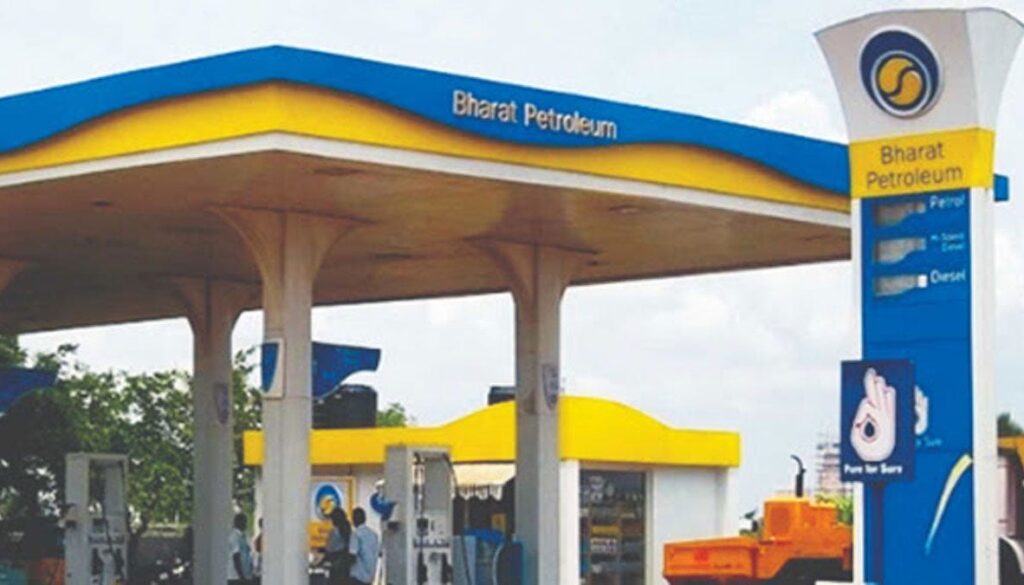
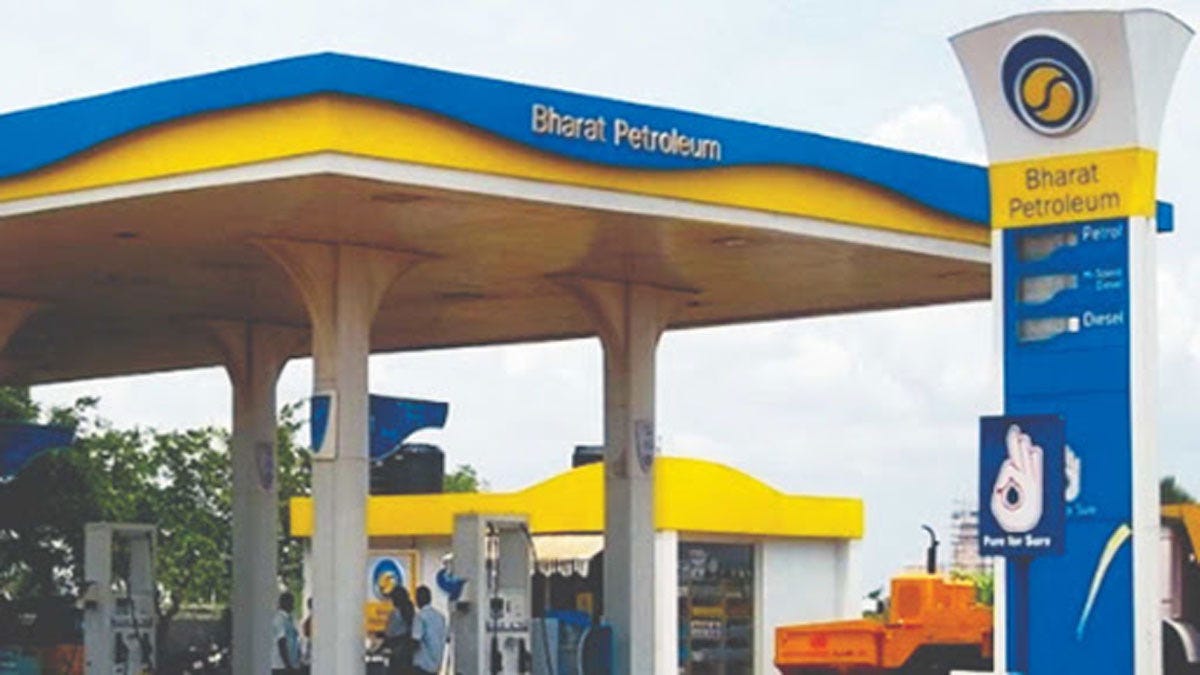
BPCL currently operates three refineries, at Mumbai, Kochi in Kerala, and Bina in Madhya Pradesh, with a combined capacity of 35.3 MMTPA, roughly 14% of India’s total refining capacity by the company’s own FY25 disclosure. During the 2019-20 privatisation process, however, BPCL’s group refining capacity was quoted at 38.3 MMTPA, because Numaligarh Refinery in Assam was still inside the portfolio at that time. The company’s retail network today spans more than 23,500 fuel stations and more than 6,200 LPG distributors, and BPCL has publicly stated it is targeting refining capacity expansion from 35.3 MMTPA toward 45 MMTPA by 2028.
Numaligarh was deliberately excluded from the BPCL strategic sale process. The 2019 Cabinet decision explicitly separated BPCL’s 61.65% stake in Numaligarh from the proposed sale and directed its transfer to another central public sector enterprise in the oil and gas sector, and the government subsequently transferred that stake to a consortium of Oil India, Engineers India, and the Government of Assam. Commentary at the time of the transaction linked the carve out to Assam’s own political sensitivities around outside control of the refinery, but that explanation does not appear stated as official government reasoning in the documents this project could verify, and it is presented here as reported context rather than an established fact.
The Privatisation Timeline
The documented sequence begins on September 30, 2019, when the Group of Secretaries on Disinvestment recommended selling the government’s entire 53.29% stake in BPCL. BPCL shares subsequently touched ₹525.30, 11.8% above the September 30 level, a move Moody’s own contemporary assessment specifically noted. The Cabinet Committee on Economic Affairs formally approved the strategic disinvestment on November 20, 2019, alongside Shipping Corporation of India and Container Corporation of India, and Oil Minister Dharmendra Pradhan told reporters the next day, November 21, that “since 2014, we have a clear vision that the government has no business to be in business.” This project searched specifically for a ministerial denial between the September rumour and the November confirmation, since that is the sequence commonly remembered, and could not substantiate one from the contemporary record. What the record does show, and what makes this genuinely more interesting than a simple denial, is that the legal groundwork had already been cleared years earlier. A 2016 Repealing and Amending Act had repealed the Burmah Shell Acquisition Act, the original nationalisation law, removing the parliamentary obstacle that had blocked a prior privatisation attempt in 2003. By October 2019, contemporary reporting was already explicitly discussing how that 2016 repeal opened the door BPCL’s sale walked through, meaning the September 2019 rumour was not an idea forming in real time. It was a policy the government had spent three years quietly clearing the runway for.
What followed took nearly three years to resolve. Rosneft CEO Igor Sechin met Pradhan in February 2020 and expressed interest, sending BPCL shares to an all time high, though one source close to the discussions indicated Rosneft’s real interest sat specifically in BPCL’s marketing business, its fuel depots and retail network, rather than the whole integrated company, a detail worth noting because it shows different bidders valued the asset differently rather than all chasing the same thing. Formal expressions of interest were invited in March 2020. By late September 2020, Reuters reported both Rosneft and Saudi Aramco had quietly stepped back from bidding, citing low oil prices and weak fuel demand. Vedanta, Apollo Global Management, and I Squared Capital’s Indian arm Think Gas were the three qualified bidders who ultimately came forward by November 2020. Apollo and I Squared later withdrew, contemporary reporting citing the complicated deal structure and an inability to secure financial or strategic backing, leaving Vedanta as effectively the sole remaining bidder. On May 26, 2022, DIPAM formally called off the process, its own notification stating that multiple Covid-19 waves and geo-political conditions had affected the global oil and gas industry and that the majority of qualified interested parties had expressed an inability to continue, cancelling the EoIs received. Two years later, in July 2024, Oil Minister Hardeep Singh Puri stated plainly that BPCL was not for sale, by which point the company had posted a cumulative net profit of roughly ₹19,000 crore in the first half of FY24 alone.
Ahead Of A Sale That Never Closed, The Company Restructured Anyway
In July 2020, with the EoI deadline for buyers approaching, BPCL introduced the Bharat Petroleum Voluntary Retirement Scheme 2020, open to employees aged 45 and above, running from July 23 to August 13, offering compensation equivalent to two months’ salary for each completed year of service. The scheme’s stated objective, per BPCL’s own annual report, was rightsizing the organisation, reducing redundancies and retaining requisite talent, while explicitly acknowledging the impending disinvestment as context. A total of 1,300 employees accepted, 243 officers and 1,057 workmen, out of a permanent workforce of 9,251 as of March 31, 2021. The more striking evidence of restructuring sits in the longer trend, not the scheme itself. BPCL’s permanent headcount fell from 13,214 in FY2013-14 to 8,594 by March 31, 2022, a decline of roughly 35%. That decline predates the 2019 privatisation announcement and cannot be attributed to it entirely, the more accurate framing is that the privatisation process accelerated an organisational rightsizing programme that was already underway, rather than starting one from scratch.
A Second Example Of The Same Pattern, At Far Greater Scale And Length
Air India offers the clearest parallel case of a rumour, retreat, and eventual confirmation cycle repeating across a much longer timeline than BPCL’s. The Vajpayee government first attempted to sell a 40% stake in 2000-01, with Singapore Airlines and the Tata Group both showing interest, before trade union opposition derailed the plan. The subsequent decade of Congress led UPA governments, 2004 to 2014, pursued no privatisation agenda for the airline, choosing instead a ₹42,182 crore turnaround and financial restructuring package approved in 2012. The Modi government revived the question, and in March 2018 formally invited bids for a 76% stake with the government retaining 24%. That structure attracted zero expressions of interest by the May 31, 2018 deadline, and Civil Aviation Minister Suresh Prabhu confirmed days later the plan had been shelved, citing the approaching general election and rising oil prices among the reasons, though those should be read as contributing factors rather than the sole official explanation. The government’s own account is that the process restarted on January 27, 2020, this time offering the entire 100% stake rather than a majority share, a structural change specifically designed to remove the residual government interference that had discouraged 2018’s bidders. Air India’s own then chairman, Ashwini Lohani, was still publicly denying rumours the airline would simply shut down as late as February 2020, even as the 100% divestment process was already moving. Financial bids were invited in April 2021, and in October 2021 the government announced Tata Group’s winning bid, Talace Private Limited’s ₹18,000 crore enterprise value offer for 100% of Air India. The lesson worth carrying back to BPCL is not just that rumour preceded confirmation twice, two decades apart, but that the structure of the offer mattered as much as the willingness to sell, a 76% sale with government strings attached found no buyers, a clean 100% sale found one within eighteen months.
Why The Deal Actually Died
The reasons BPCL’s privatisation collapsed cluster around the same structural theme this project has already established across the IOCL and HPCL pieces. Contemporary reporting explicitly identified a lack of clarity around domestic fuel pricing as a major deterrent, at a time when public sector retailers controlled roughly 90% of petrol and diesel sales and were periodically selling below cost during price suppression episodes, the exact policy risk a private buyer would be underwriting alongside the physical assets. Layer onto that the pandemic’s disruption of due diligence timelines and the 2022 spike in global energy prices raising the cost of acquisition financing at the worst possible moment, and the eventual May 2022 withdrawal reads less as a single failure and more as the accumulation of headwinds this project has already documented independently arriving at once. The same problem that complicated the sale in 2020 and 2021 is visible directly in BPCL’s Q1 FY27 income statement, a company whose commercial economics can still be overridden by public policy, still losing money in a quarter of exceptional refining strength, for precisely the reason global buyers cited as their hesitation five years earlier.
The Stress Test
BPCL’s own earnings call for the quarter described spot crude purchases rising sharply to 69% of total procurement, reflecting supply chain flexibility rather than distress, and management held full year capital expenditure guidance at ₹25,000 crore, explicitly stating it would not back away from planned projects, including the 35.3 to 45 MMTPA refining expansion. Refinery throughput came in at 10.15 MMT, with capacity utilisation of 115%, even as domestic sales edged up 0.29% to 13.62 MMT, a company running its physical operations essentially flat and expanding while its financial results swung sharply on the crude spike and pricing lag mechanism now familiar across all three issues in this series. That is the actual shape of the story. The privatisation failed. The restructuring, and the capital discipline behind it, did not, and the company that emerged from a three year sale process it never completed is leaner, still state owned, and expanding capacity into a market its own government still will not let it price freely.
Sources: DIPAM’s May 26, 2022 notification on the withdrawal of the BPCL strategic disinvestment process. Business Standard, ANI, Tribune, and Asianet Newsable reporting on BPCL and HPCL Q1 FY27 results, July 2026, including Nuvama’s analyst commentary. Investing.com’s BPCL Q1 FY27 earnings call transcript. BPCL’s own FY25 annual report and company website disclosures on refining capacity and retail network. BPCL’s annual report disclosure on the 2020 Voluntary Retirement Scheme and permanent employee headcount. Business Standard reporting on the September 2019 Group of Secretaries recommendation and the November 2019 CCEA approval. Reuters reporting on Rosneft and Saudi Aramco’s withdrawal from BPCL bidding, September 2020. Business Today and People Matters reporting on BPCL’s 2020 VRS terms. National Herald and Gulf News reporting on the Air India privatisation chronology, 2000 through 2021, and the Government of India’s own record of the Talace winning bid.