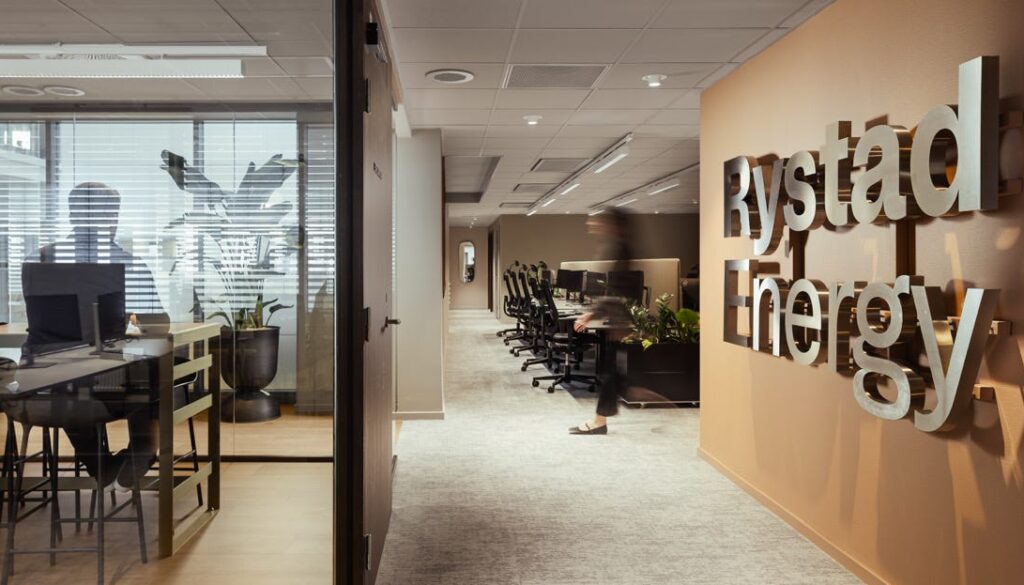
Rystad Energy
Janiv Shah sat on Squawk Box Europe in July and told the anchors investors were getting
nervous about tolls on the Strait of Malacca, then said he was unfortunately unable to share more. That sentence is the entire Rystad Energy business model compressed into one soundbite. Say something a trading desk needs, imply there is more behind the paywall, let the free clip do the marketing. Three of the firm’s own people, Claudio Galimberti, Jorge Leon, and Janiv Shah, have carried that same play across CNBC through 2026, on Hormuz, on the oil glut, on Malacca. It works. It is also, on the company’s own filed numbers, not making Rystad Energy money.
The pitch
Rystad Energy was founded in Oslo in 2004 by Jarand Rystad, who still owns the majority of the company himself, with minority shares held by senior staff. No private equity round, no strategic acquirer, no IPO. Twenty two years of organic growth built entirely on one proposition, that the firm’s own analysts, several hundred of them, can process public filings, satellite data, well level production records, and shipping data faster and more usefully than a bank or an operator’s own internal team can do it themselves.
The product line by 2026 spans Upstream Solutions (field by field global E&P databases down to well level), OFS Solutions (oilfield services spend and rig demand tracking), Shale Solutions (North American well production, M&A, and play economics), Market Solutions (short and long term oil and gas market outlooks), a growing Energy Transition and Power vertical (offshore wind, hydrogen, CCS, grid), and a standing Advisory arm that sells bespoke strategy work to operators, governments, and financial institutions on top of the subscription base. In 2026 the firm layered on Spektra, an AI native version of its platform with an assistant called AskRystad and API access built for AI agents through the Model Context Protocol. That last move matters more than a routine product launch, and I will come back to it.
What the growth story actually says
In April 2024 Jarand Rystad told Finansavisen his company had crossed 1 billion Norwegian kroner in revenue for the first time, after roughly doubling in two years, and that he intended to hire several hundred more people. That is a real number and a real quote, and it is the version of the company that gets repeated in every writeup, including most of the ones I read before starting this piece.
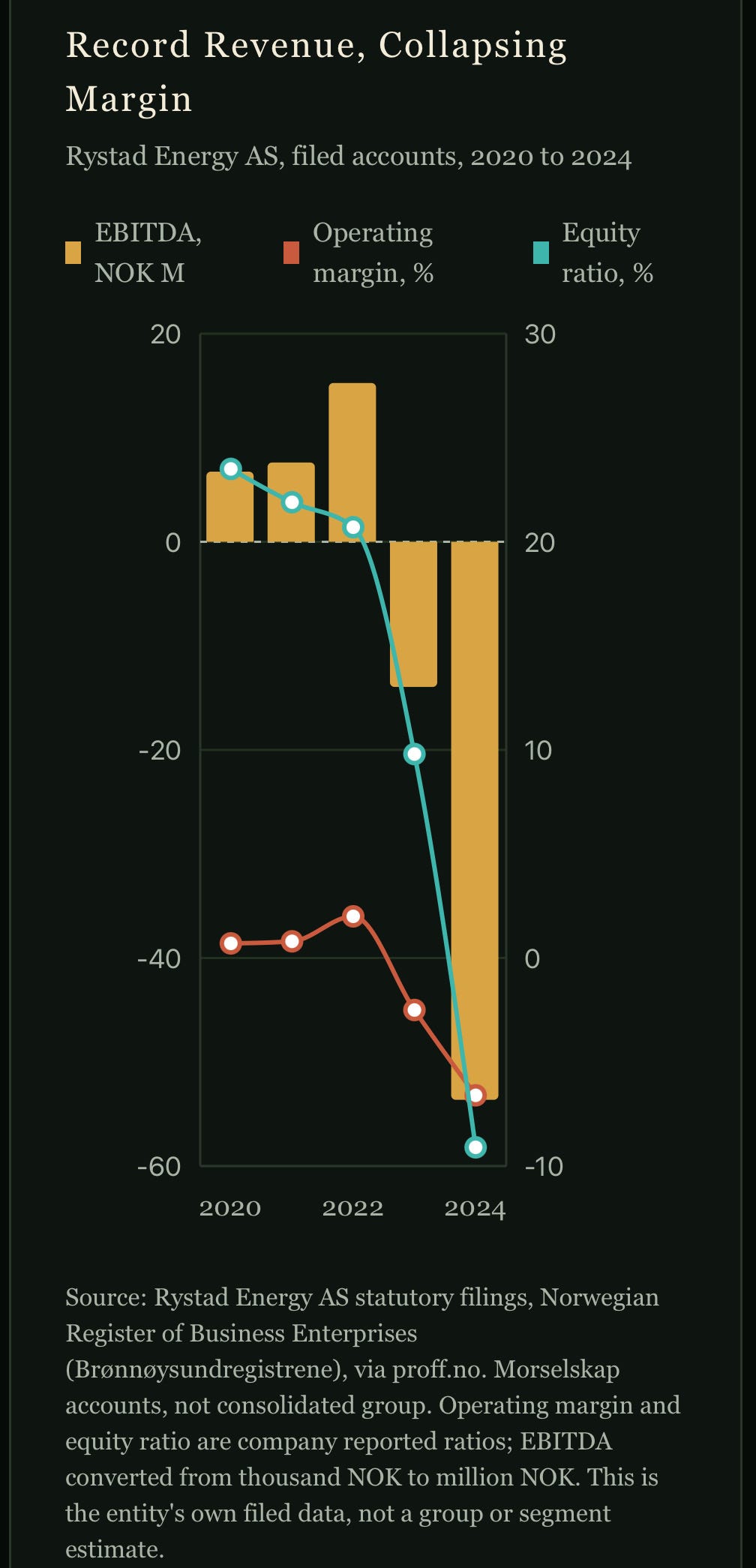
The company’s own statutory filings with the Norwegian business register, five years of them, tell a second half of the story that almost never makes it into the press coverage. Operating margin ran 0.7% in 2020, 0.8% in 2021, 2.0% in 2022, thin but positive and stable. Then it flipped to negative 2.5% in 2023 and negative 6.6% in 2024, the exact two years the company was telling journalists it had doubled revenue and crossed 1 billion kroner for the first time. EBITDA follows the same line, NOK 6.74M in 2020, 7.62M in 2021, 15.26M in 2022, then negative 13.95M in 2023 and negative 53.63M in 2024. The equity ratio, shareholder equity as a share of total assets, fell from 23.5% in 2020 to 21.9%, 20.7%, 9.8%, and then negative 9.1% by the 2024 filing. A company whose liabilities now exceed its assets is not a rounding footnote. It is a business that financed its own growth by spending down its own solvency, one year at a time, in full public view of anyone who checked the filing instead of the press release.
Put a number on the most recent year alone and the picture does not improve. Revenue of roughly NOK 1.33B, about $140M at current exchange rates, produced a filed operating loss of close to $7-8M and negative equity of roughly $14M. A firm that just posted its best revenue year ever, in a business famous for high margin analyst subscriptions, filed an operating loss and negative equity in the same period, and the five year trend shows this was not a one time write down but a steady slide that started the moment the growth story accelerated.
Why a data company loses money on record revenue
Compare Rystad against the one competitor whose numbers were actually audited by an outside buyer at the point of sale. Wood Mackenzie, founded in Edinburgh in 1923 with an energy research arm running since 1973, was bought by Hellman and Friedman in 2015 on 2014 financials of £227M revenue and £107M EBITDA, a margin of 47.1%. It changed hands again in 2022, sold by Verisk to Veritas Capital for $3.1B. As of 2025 it runs roughly 2,500 employees across more than 30 locations. That is what a mature, well capitalized energy intelligence business looks like on paper, a data and analytics operation with software level margins riding on top of a large but efficiently deployed analyst base.
Rystad Energy at somewhere between 900 and 960 employees by mid 2026, according to third party workforce trackers (the company’s own last disclosed figure was 700 in the 2024 press cycle, so treat the newer estimates as directional rather than confirmed), is running the same labor intensive model, analysts pulling apart filings and satellite imagery and turning it into forecasts and quotable soundbites, without Wood Mackenzie’s decades of embedded enterprise contracts or a private equity balance sheet behind it. Every dollar of new revenue has been funded by hiring more analysts rather than by software leverage, and the filed accounts show that treadmill costs more than it currently returns. Rystad is fundamentally a database and manpower company than the platform framing the company itself prefers, and the accounts back it up in a way the marketing never will.
The information itself is not the moat
None of the raw inputs Rystad sells are exclusive. IEA, OPEC, USGS, national petroleum directorates, and company filings are open to anyone with the patience to compile them, which is exactly what Wood Mackenzie, S&P Global Commodity Insights, Enverus, GlobalData, TGS, Energy Aspects, and smaller shops like Facts Global Energy all do in parallel, competing for the same institutional subscription budget. Rystad’s real product was never the data. It was Jarand Rystad’s own reputation as, in the Financial Times’ words, one of the most cited petroleum analysts in the industry, and the same halo effect now sitting on his chief economist and his geopolitical and commodity market leads every time CNBC needs a quote on Hormuz or Malacca.
That media reach is free distribution, and it is genuinely effective distribution. It is also structurally hard to defend, because a competing analyst at Wood Mackenzie or S&P can say something equally quotable next week, and the institutional buyer choosing between subscription renewals is still comparing databases and coverage depth, not who was on Squawk Box last month.
S&P Global’s Commodity Insights segment, the direct peer business line sitting inside a public parent, is the cleanest scale comparison available, since it discloses audited segment margins every quarter. It posted a 42% operating margin in the first quarter of 2025 alone, on quarterly revenue of $612M, more than four times Rystad Energy’s entire annual revenue. That segment ran a 35% margin back in 2022 and has only widened since. This is the margin structure Rystad’s own website implies it competes on when it talks about proprietary databases and analyst maintained data. It is not the margin structure the Norwegian filings actually show.
Spektra is the tell
Launching an AI native platform with an assistant and API access built for autonomous agents is not a routine feature release for a company with this cost structure. It is an attempt to convert a headcount driven margin problem into a software driven one, the same trade every research and advisory business with a people cost base is trying to make right now. If Spektra genuinely lets a client query well level production data or rig demand forecasts through an agent instead of paying an analyst to compile a custom deck, the operating result the accounts show today could look very different within two or three fiscal years. If it turns into another interface layered on top of the same manual research process, the company adds engineering cost on top of an already negative operating line without solving the underlying problem.
Stress test
Set Rystad against a scenario where the AI transition compresses pricing across the entire research and advisory category rather than lifting Rystad specifically. If S&P Global and Wood Mackenzie, both sitting on far larger balance sheets, ship comparable AI agent access to their own databases at the same time, Rystad loses its most differentiated 2026 announcement within a single product cycle, while still carrying the analyst headcount it built to win the old subscription war. Layer on Claudio Galimberti’s own June 2026 call, made on Squawk Box Asia, that the current oil deficit could flip into what he called a humongous surplus by 2027. A prolonged low volatility, oversupplied oil market is historically the environment in which trading desks and operators cut discretionary data spend first, since the forecasting stakes feel lower. A company already running a negative operating result on its best revenue year, with a media strategy built on being quoted during exactly the kind of high volatility events a 2027 surplus would suppress, is stress tested on two fronts at once by its own chief economist’s forecast.
The label
Rystad Energy narrates. It takes public and licensed data that half a dozen competitors can also access, runs it through several hundred analysts, and sells the resulting story, in report form, in advisory decks, and increasingly for free on CNBC, to an industry that will pay for a confident voice more readily than it will pay for a spreadsheet. That model built a real business and a real reputation over two decades. It has not yet built a margin that matches the revenue headline, and the company’s own newest product is the clearest evidence that its own management knows it.
Twenty two years of doubling revenue and Rystad Energy is still telling a better story about itself than its balance sheet can currently back up. The real test of a research firm was never how often its economists get quoted on live television. It is whether the business behind the soundbite can fund its own growth without hiring its way into a deeper hole every time revenue sets a record.